<?xml version="1.0" encoding="utf-8"?>
<!DOCTYPE html PUBLIC "-//W3C//DTD XHTML 1.1//EN"
  "http://www.w3.org/TR/xhtml11/DTD/xhtml11.dtd">

<html xmlns="http://www.w3.org/1999/xhtml">
<head><title>A Guide to the Birds of New England and Eastern New York</title>
<style type="text/css">
.flow {
  margin: 0;
  font-size: 1em;
}
.flow .pagebreak {
  page-break-before: always;
}
.flow p {
  text-align: left;
  text-indent: 0;
  margin-top: 0;
  margin-bottom: 0.5em;
}
.flow .gstxt_sup {
  font-size: 75%;
  position: relative;
  bottom: 0.5em;
}
.flow .gstxt_sub {
  font-size: 75%;
  position: relative;
  top: 0.3em;
}
.flow .gstxt_hlt {
  background-color: yellow;
}
.flow div.gtxt_inset_box {
  padding: 0.5em 0.5em 0.5em 0.5em;
  margin: 1em 1em 1em 1em;
  border: 1px black solid;
}
.flow div.gtxt_footnote {
  padding: 0 0.5em 0 0.5em;
  border: 1px black dotted;
}
.flow .gstxt_underline {
  text-decoration: underline;
}
.flow .gtxt_heading {
  text-align: center;
  margin-bottom: 1em;
  font-size: 150%;
  font-weight: bold;
  font-variant: small-caps;
}
.flow .gtxt_order {
  text-align: center;
  font-size: 120%;
  font-weight: bold;
  text-align:center
}
.flow .gtxt_h1_heading {
  text-align: center;
  font-size: 140%;
  font-weight: bold;
  text-align:center
  page-break-before: always;
}

.flow .gtxt_h2_heading {
  font-size: 110%;
  text-align:center;
  font-weight:bold;
  page-break-before: always;
}
.flow .gtxt_h3_heading {
  text-align:center;
  page-break-before: always;
}

.flow .gtxt_lineated {
  margin-left: 2em;
  margin-top: 1em;
  margin-bottom: 1em;
  white-space: pre-wrap;
}
.flow .gtxt_lineated_code {
  margin-left: 2em;
  margin-top: 1em;
  margin-bottom: 1em;
  white-space: pre-wrap;
  font-family: monospace;
}
.flow .gtxt_quote {
  margin-left: 2em;
  margin-right: 2em;
  margin-top: 1em;
  margin-bottom: 1em;
}
.flow .gtxt_list_entry {
  margin-left: 2ex;
  text-indent: -2ex;
}
.flow .gimg_graphic {
  margin-top: 1em;
  margin-bottom: 1em;
}
.flow .gimg_table {
  margin-top: 1em;
  margin-bottom: 1em;
}
.flow {
  font-family: serif;
}
.flow span,p {
  font-family: inherit;
}
<!-- The Picture galleries - code taken from
https://www.w3schools.com/css/tryit.asp?filename=trycss_image_gallery_responsive -->
div.gallery {
  margin: 5px;
  border: 1px solid #ccc;
}

div.gallery:hover {
  border: 1px solid #777;
}

div.gallery img {
  width: 100%;
  height: auto;
}

div.desc {
  padding: 15px;
  text-align: center;
}

* {
  box-sizing: border-box;
}

.responsive {
  padding: 0 6px;
  float: left;
  width: 24.99999%;
}

@media only screen and (max-width: 1280px) {
  .responsive {
    width: 49.99999%;
    margin: 6px 0;
  }
}

@media only screen and (max-width: 640px) {
  .responsive {
    width: 100%;
  }
}

.clearfix:after {
  content: "";
  display: table;
  clear: both;
}

<!-- End of gallery styles -->
</style>
</head>
<body>
<div class='flow' style=''>
<a class='page' id='GBS.PA215'></a>


<div id='block.94.1.0.box.248.374.906.107.q.101' class='gtxt_body' style='margin-bottom: 1.5em;'>
<a id='GBS.PA71.w.1.0.0'></a><p class='gtxt_h3_heading' style='text-align:center;' id='para.94.1.0.box.248.374.906.46.q.101'>BIRDS OF NEW ENGLAND AND EASTERN NEW YORK - HOFFMANN</p>

<p class='gtxt_body' id='next_page' style="text-align: center;">
<a href="nighthawks.xml">Previous Page</a>
- 
<a href="toc.xml">Table of Contents</a>

-
<a href="kingfishers.xml">Next Page</a>

</p>
</div>

<div id='block.242.3.0.box.322.599.800.39.q.101' class='gtxt_body' style='margin-bottom: 1.5em;'>
<p class='gtxt_order' style='text-indent:1em;text-align:center' id='order_pici'>WOODPECKERS, ETC.: <a href="toc.xml#toc_order_pici">ORDER PICI</a></p>
</div>
<div id='block.242.4.0.box.370.682.703.32.q.101' class='gtxt_body' style='margin-bottom: 1.5em;'>
<a id='GBS.PA215.w.4.0.0'></a><p class='gtxt_h2_heading' style='text-indent:1em;text-align:center' id='family_picidae'>WOODPECKERS: <a href="toc.xml#toc_family_picidae">FAMILY PICIDÆ</a></p>
</div>
<div id='block.242.5.0.box.216.753.1019.1131.q.101' class='gtxt_body'>
<a id='GBS.PA215.w.5.0.0'></a><p class='gtxt_body' style='text-indent:1em;' id='para.242.5.0.box.216.753.1019.1131.q.101'>Eight species of Woodpecker occur in New York and New England. Only two, however, the Downy and the Flicker, are common residents throughout this area. The Hairy Woodpecker is very similar to the Downy, and is generally confined to regions which have a certain amount of good-sized timber, while the Pileated Woodpecker lives only in deep forests. The Sapsucker breeds in northern New York and New England, and occurs as a migrant elsewhere. The Red-headed Woodpecker occurs only in southern and western New England and in eastern New York. The two Three-toed Woodpeckers are confined to the forests of northern New York and New England. The habitual resorts of all Woodpeckers are the trunks and large limbs of trees, though, except in the breeding season, the Flicker is nearly as often seen on the ground, where it feeds on ants, as on trees, to which it resorts chiefly as a perch. Woodpeckers all fly in great undulations, holding their wings close to the body for an instant, then rising by means of two or three more strokes. Most of the Woodpeckers feed on the larvæ of borers which they extract from the trunks or limbs of trees; they are, therefore, permanent residents. The Sapsucker, however, and Flicker are not adapted to feed on borers, and are therefore migrants.</p>
</div>
</div>
<br/>
<div class='flow' style=''>
<a class='page' id='GBS.PA216'></a>
<div id='block.243.1.0.box.167.185.1008.489.q.101' class='gtxt_body' style='margin-bottom: 1.5em;'>
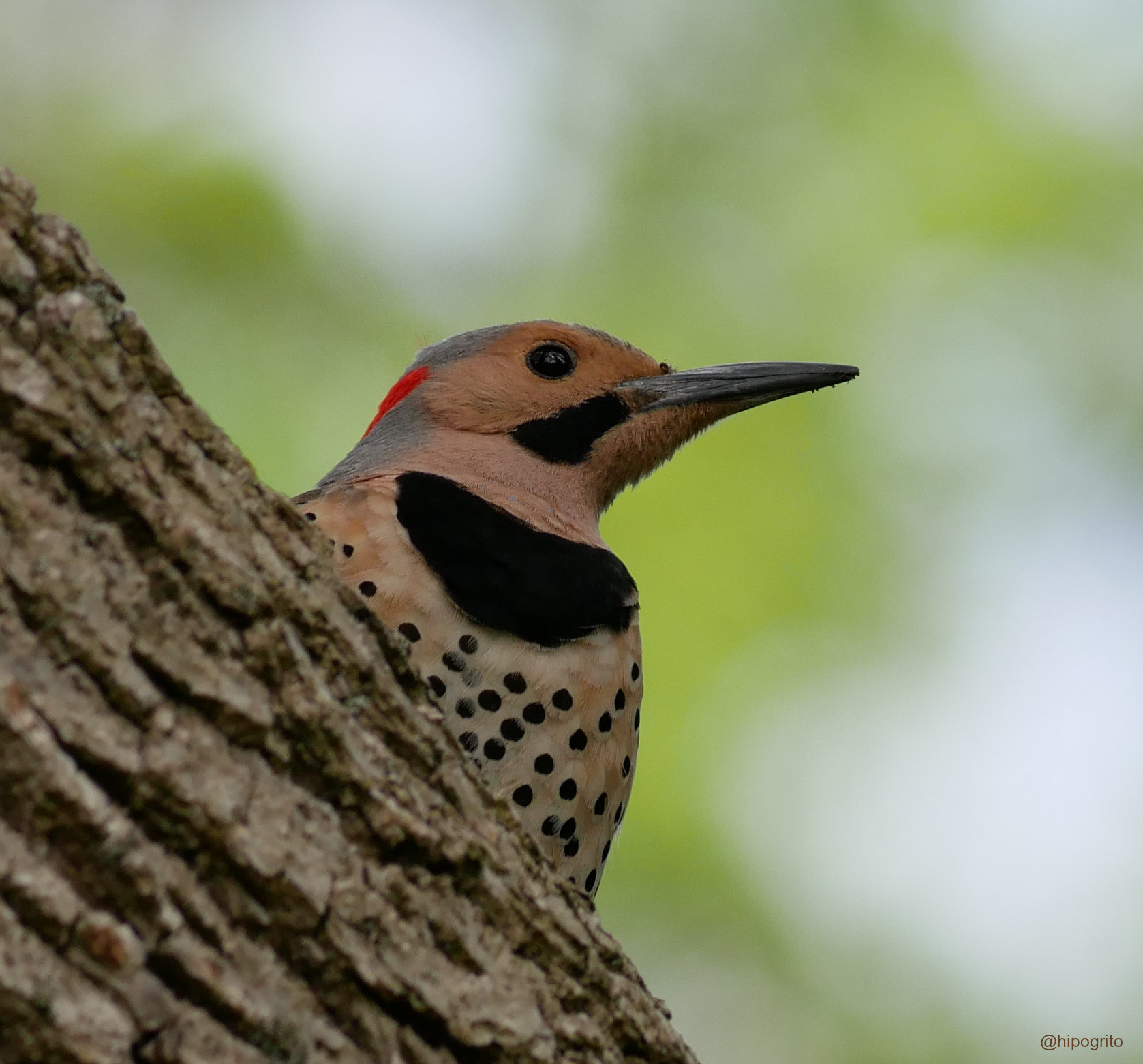
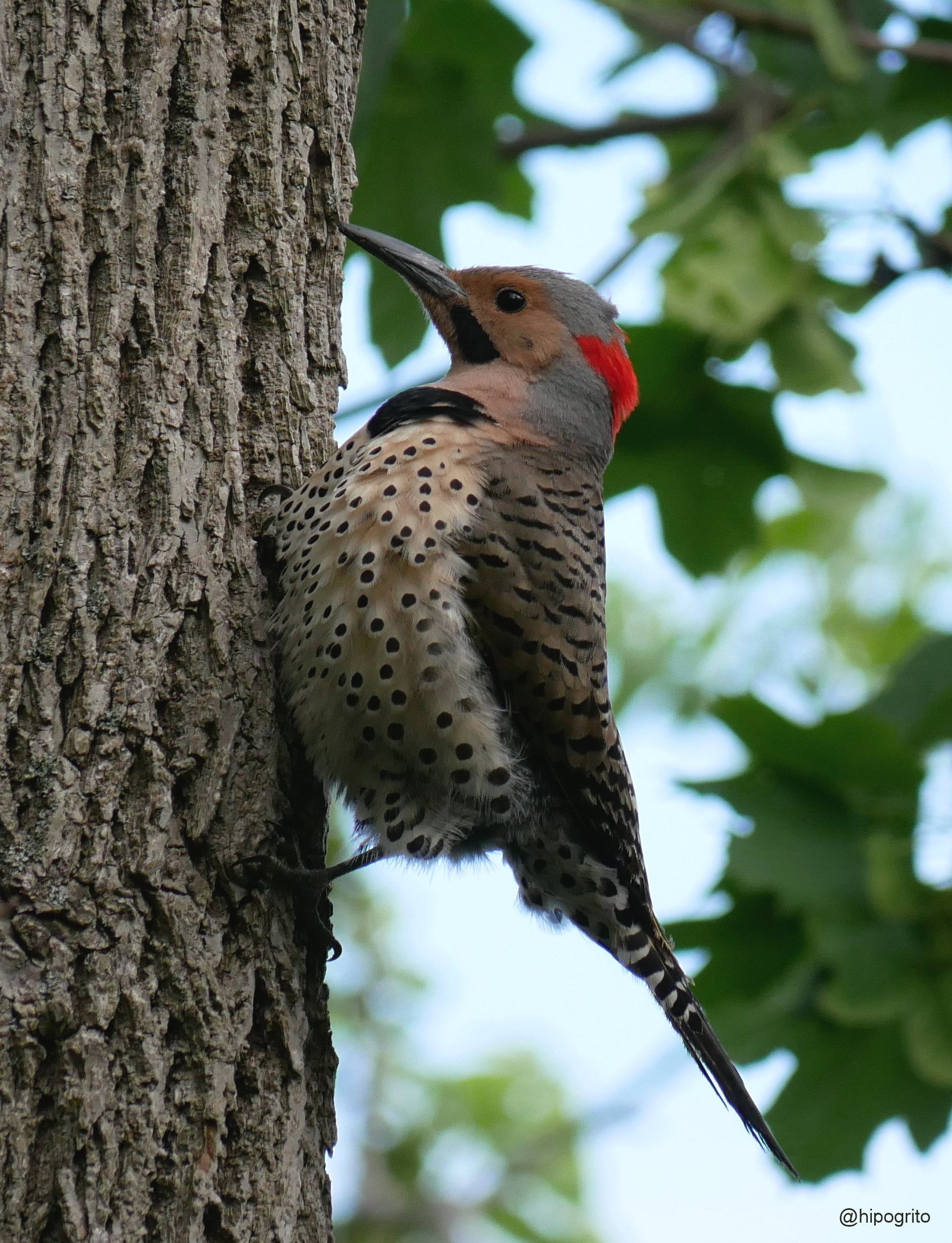
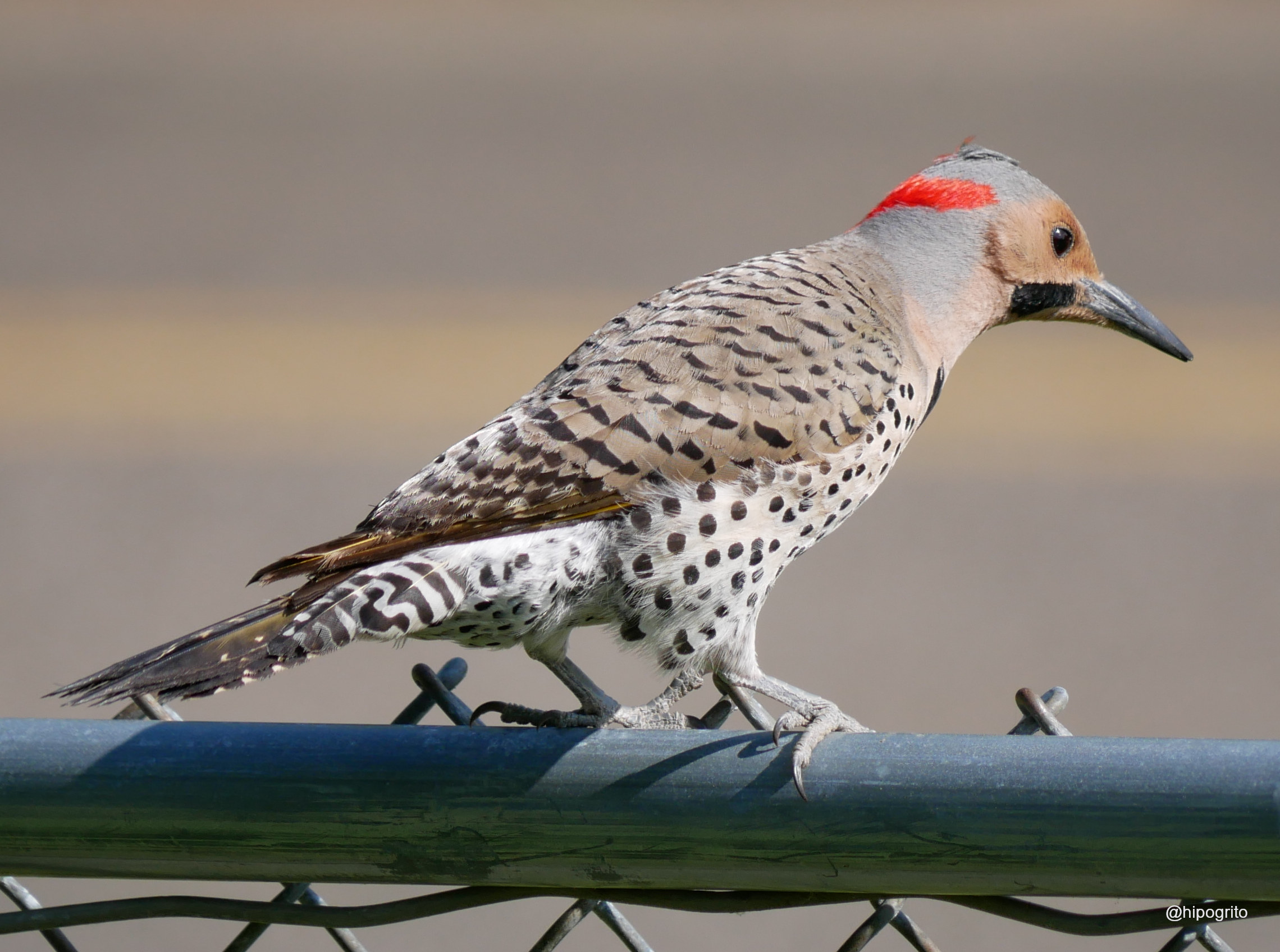
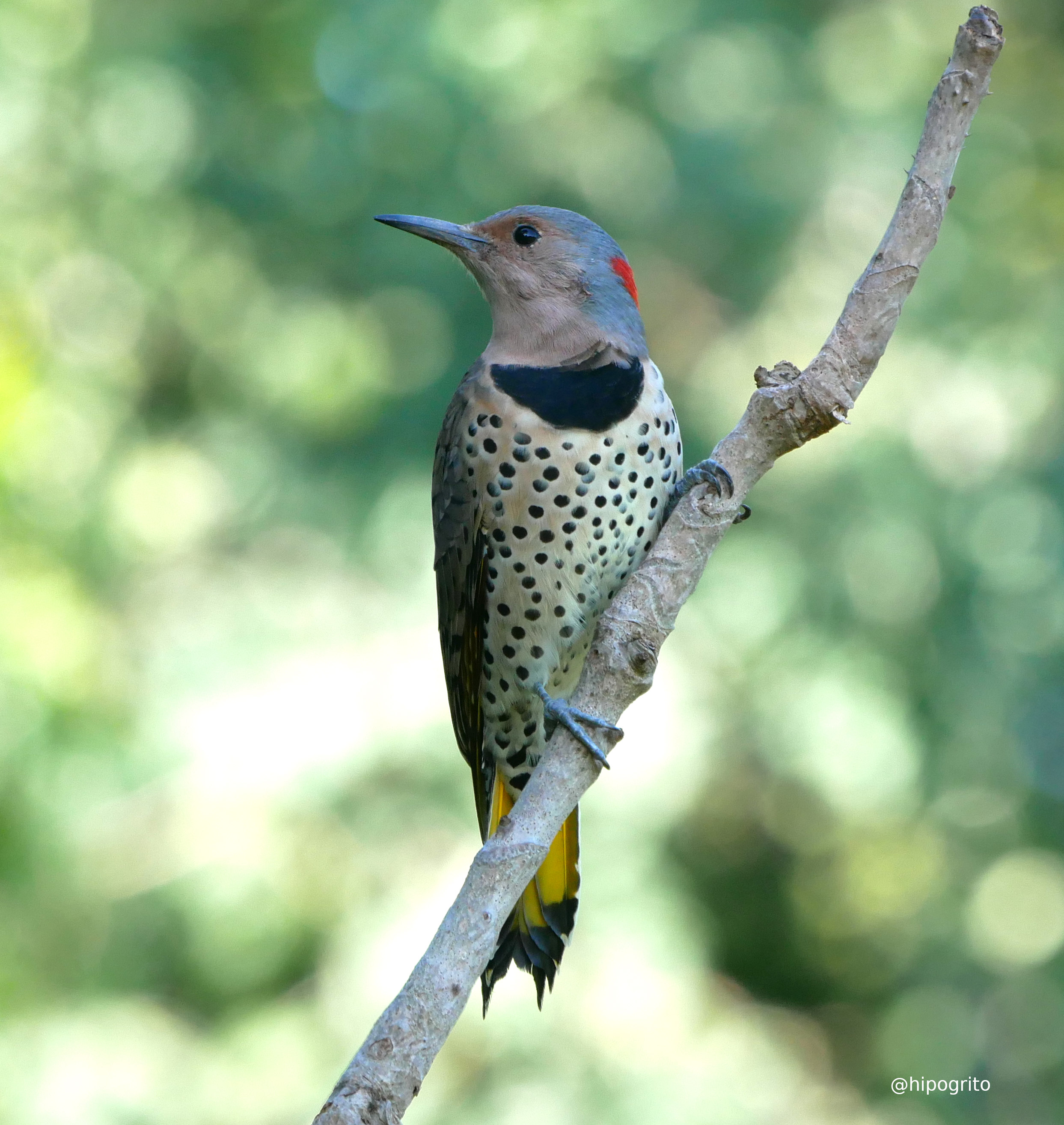
<a id='GBS.PA216.w.1.0.0'></a><p class='gtxt_h3_heading' style='margin-bottom: 1.5em;text-align:center' id='flicker'><a href="toc.xml#toc_flicker">NORTHERN FLICKER; GOLDEN-WINGED WOODPECKER.</a> <span style='font-style:italic;'>Colaptes auratus luteus </span><br/>12.00 in.</p>
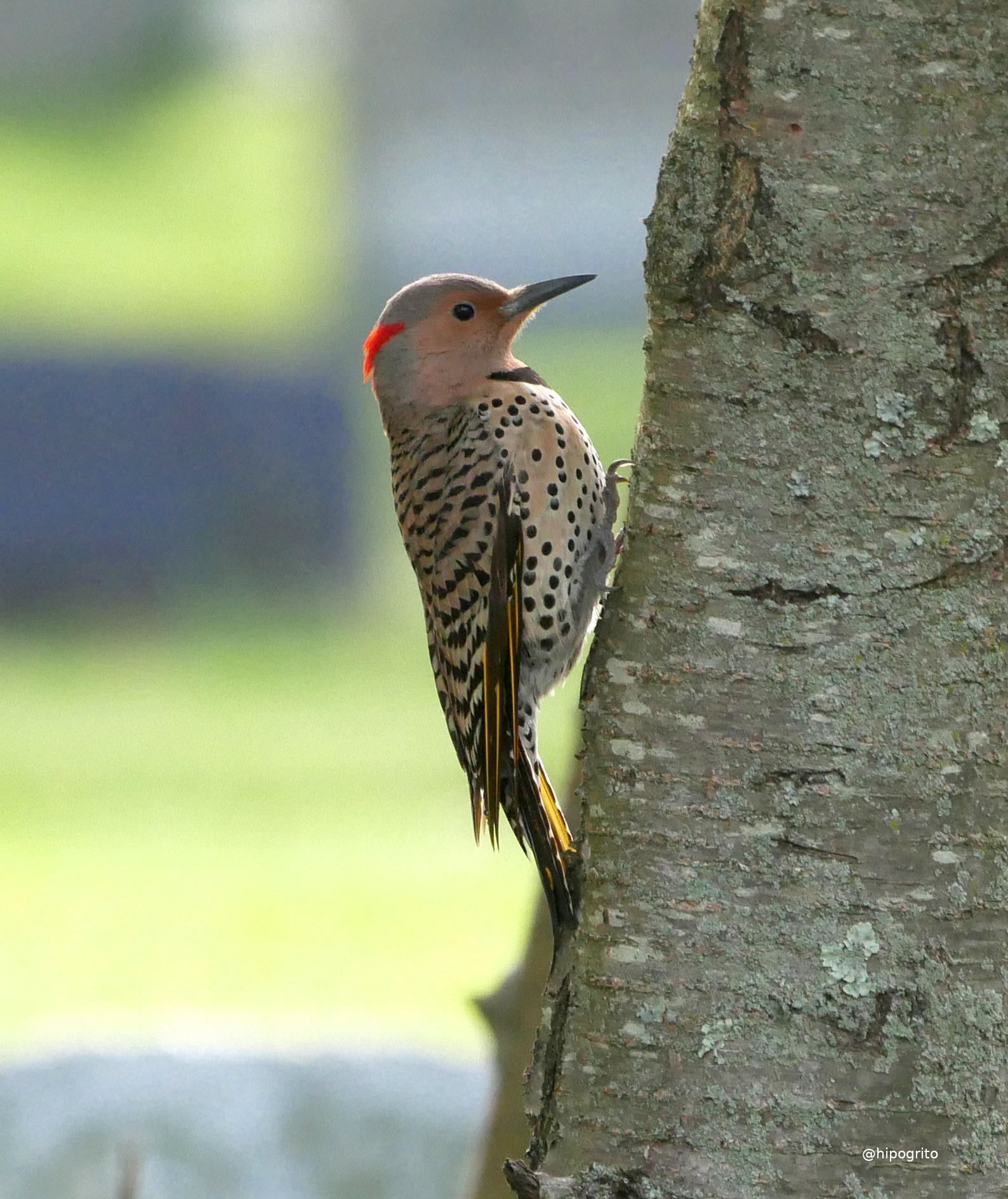
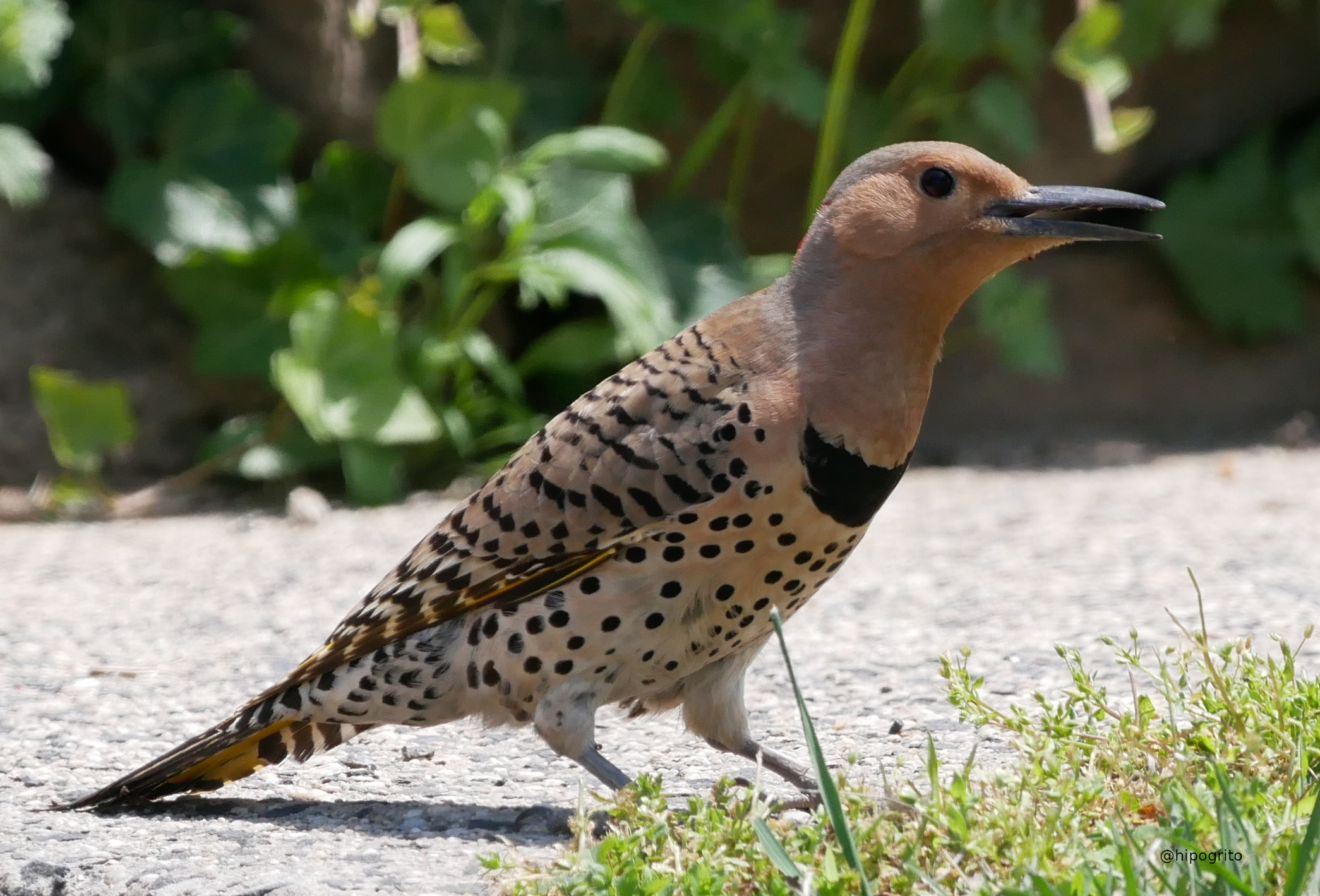
<a id='GBS.PA216.w.1.2.0'></a><p class='gtxt_body' style='text-indent:1em;' id='para.243.1.2.box.205.279.508.119.q.101'><span style='font-style:italic;font-weight:bold'>Ad. ♂.— </span> Head grayish-brown, a scarlet band across nape of neck; back brown, barred with black; wings and tail black; <span style='font-style:italic;'>shafts </span><span style='font-style:italic;'>and </span><span style='font-style:italic;'>under </span><span style='font-style:italic;'>sides </span><span style='font-style:italic;'>of </span><span style='font-style:italic;'>wings </span>and tail-feathers <span style='font-style:italic;'>golden</span><span style='font-style:italic;'>-</span><span style='font-style:italic;'>yellow</span><span style='font-style:italic;'>; </span><span style='font-style:italic;'>rump </span><span style='font-style:italic;'>white</span><span style='font-style:italic;'>; </span>throat pinkish-brown; line along side of throat and band across upper breast black; rest of under parts buffy, marked with round black spots. <span style='font-style:italic;font-weight:bold'>Ad. ♀.—</span> Similar, but without the black line along the side of the throat.</p>


<a id='GBS.PA216.w.1.4.0'></a><p class='gtxt_body' style='text-indent:1em;' id='para.243.1.4.box.205.632.676.42.q.101'><span style='font-style:italic;font-weight:bold'>Nest</span>, in a hole in a dead limb. <span style='font-style:italic;font-weight:bold'>Eggs</span><span style='font-style:italic;'>, </span>white.</p>

<div class="responsive">
  <div class="gallery">
    <a target="_blank" href="../data/flicker_02.JPG">
     
      <img src='../data/flicker_02.JPG' style=' ' alt='Northern Flicker'/>
    </a>
    <div class="desc">Long Island, NY, 2021</div>
  </div>
</div>

<div class="responsive">
  <div class="gallery">
    <a target="_blank" href="../data/flicker_01.JPG">
     
      <img src='../data/flicker_01.JPG' style=' ' alt='Northern Flicker'/>
    </a>
    <div class="desc">Long Island, NY, 2021</div>
  </div>
</div>


<div class="responsive">
  <div class="gallery">
    <a target="_blank" href="../data/flicker_03.JPG">
     
      <img src='../data/flicker_03.JPG' style=' ' alt='Northern Flicker'/>
    </a>
    <div class="desc">Long Island, NY, 2021</div>
  </div>
</div>


<div class="responsive">
  <div class="gallery">
    <a target="_blank" href="../data/flicker_2022_w02.JPG">
     
      <img src='../data/flicker_2022_w02.JPG' style=' ' alt='Northern Flicker'/>
    </a>
    <div class="desc">Dix Hills, Long Island, NY, 2022</div>
  </div>
</div>


<div class="responsive">
  <div class="gallery">
    <a target="_blank" href="../data/flicker_2023_04.JPG">
     
      <img src='../data/flicker_2023_04.JPG' style=' ' alt='Northern Flicker'/>
    </a>
    <div class="desc">Northport, Long Island, NY, 2023</div>
  </div>
</div>


<div class="responsive">
  <div class="gallery">
    <a target="_blank" href="../data/flicker_2023_02.JPG">
     
      <img src='../data/flicker_2023_02.JPG' style=' ' alt='Northern Flicker'/>
    </a>
    <div class="desc">Northport, Long Island, NY, 2023</div>
  </div>
</div>

<div class="responsive">
  <div class="gallery">
    <a target="_blank" href="../data/flicker_2022_02.JPG">
     
      <img src='../data/flicker_2022_02.JPG' style=' ' alt='Northern Flicker'/>
    </a>
    <div class="desc">Long Island, NY, 2022</div>
  </div>
</div>


<div class="responsive">
  <div class="gallery">
    <a target="_blank" href="../data/flicker_2022_04.JPG">
     
      <img src='../data/flicker_2022_04.JPG' style=' ' alt='Northern Flicker'/>
    </a>
    <div class="desc">Long Island, NY, 2022</div>
  </div>
</div>

<div class="clearfix"></div>


<a id='GBS.PA216.w.2.0.0'></a><p class='gtxt_body' style='text-indent:1em;' id='para.243.2.0.box.169.705.1004.95.q.101'>Near the sea-coast, from Massachusetts southward, and in the lower Hudson Valley, the Flicker is not uncommon in winter. In the rest of New England it is only a summer resident, common everywhere except in the northern heavily-forested regions. The migrants return in March or April, and are then extremely noisy; their loud <span style='font-style:italic;'>wick </span><span style='font-style:italic;'>wick </span><span style='font-style:italic;'>wick </span><span style='font-style:italic;'>wick </span>is one of the characteristic sounds of a bright spring morning. This is generally the cry of the male only, who also delivers at this season a tattoo on a resonant limb, which may often be heard in the pauses of the loud call.</p>

<div id='block.243.3.0.box.208.840.928.576.q.101' class='gimg_graphic'>
<img src='../data/content-0166.png' style='max-width:100%; max-height:100%' alt='[graphic][merged small]'/></div>
</div>
</div>
<div class='flow' style=''>

<div id='block.244.2.0.box.230.192.1010.1459.q.101' class='gtxt_body' style='margin-bottom: 1.5em;'>
<a id='GBS.PA217.w.2.0.0'></a><p class='gtxt_body' style='text-indent:1em;' id='para.244.2.0.box.230.192.1006.338.q.101'>The ordinary call-note of the Flicker is a high-pitched <span style='font-style:italic;'>ti</span><span style='font-style:italic;'>-</span><span style='font-style:italic;'>err</span><span style='font-style:italic;'>, </span>often confused by beginners with the <span style='font-style:italic;'>teer </span>of the <a href="crows.xml#blue_jay">Blue Jay</a>. The Flicker's note is sharper, less prolonged, and has a marked downward inflection; it is, moreover, usually given but once, or repeated only after a little interval, whereas the Jay generally screams two or three times in quick succession.</p>
<a id='GBS.PA217.w.2.1.0'></a><p class='gtxt_body' style='text-indent:1em;' id='para.244.2.1.box.232.534.1004.629.q.101'>When two or more birds come together, the males spread wings and tail, bowing and turning, while both sexes utter a note, like the syllables <span style='font-style:italic;'>yuck</span><span style='font-style:italic;'>'</span><span style='font-style:italic;'>-</span><span style='font-style:italic;'>a </span><span style='font-style:italic;'>yuck</span><span style='font-style:italic;'>'</span><span style='font-style:italic;'>-</span><span style='font-style:italic;'>a </span><span style='font-style:italic;'>yuck</span><span style='font-style:italic;'>'</span><span style='font-style:italic;'>-</span><span style='font-style:italic;'>a</span><span style='font-style:italic;'>. </span>At such a time the full beauty of the plumage is displayed, the large black dots on the breast, the red band on the ashy nape, the black collar on the breast, and the black mustaches of the male. Ordinarily, however, the bird looks merely brown. When uttering the long, loud call, the male often perches across a large twig or small limb, but as a rule he alights on the upright trunk of a tree after the fashion of other Woodpeckers. In spring and summer Flickers spend much time on the ground, feeding on ants; and in autumn they eat greedily of black cherries.</p>
<a id='GBS.PA217.w.2.2.0'></a><p class='gtxt_body' style='text-indent:1em;' id='para.244.2.2.box.234.1169.1006.482.q.101'>The eggs are laid in a hole excavated by the birds, generally in a dead limb, with a large circular opening. The same nest is often used over and over. If one raps on the trunk of a tree so occupied in May, the startled female often appears for an instant in the opening and then hurries off. At such a time, when the bird flies directly overhead, the <span style='font-style:italic;'>golden </span><span style='font-style:italic;'>under </span><span style='font-style:italic;'>sides </span><span style='font-style:italic;'>of </span><span style='font-style:italic;'>the </span><span style='font-style:italic;'>wing </span>and tail-feathers show; ordinarily, the Flicker is readily identified by its size and peculiar flight and by the <span style='font-style:italic;'>white </span><span style='font-style:italic;'>rump</span><span style='font-style:italic;'>, </span>which shows as it flies from one group of trees to the next.</p>
</div>
<br/>
<div id='block.244.3.0.box.235.1701.1002.194.q.101' class='gtxt_body'>
<a id='GBS.PA217.w.3.0.0'></a><p class='gtxt_h3_heading' style='margin-bottom: 1.5em;text-align:center' id='red_headed_woodpecker'><a href="toc.xml#toc_red_headed_woodpecker">RED-HEADED WOODPECKER</a>. <span style='font-style:italic;'>Melanerpes erythrocephalus </span><br/>9.75 in.</p>
<a id='GBS.PA217.w.3.1.0'></a><p class='gtxt_body' style='text-indent:1em;' id='para.244.3.1.box.235.1763.1002.131.q.101'><span style='font-style:italic;font-weight:bold'>Ad.— </span><span style='font-style:italic;'></span><span style='font-style:italic;'>Whole </span><span style='font-style:italic;'>head </span><span style='font-style:italic;'>and </span><span style='font-style:italic;'>upper </span><span style='font-style:italic;'>breast </span><span style='font-style:italic;'>crimson</span><span style='font-style:italic;'>; </span>upper back, wings, and tail bluish-black; lower back, <span style='font-style:italic;'>wide </span><span style='font-style:italic;'>band </span><span style='font-style:italic;'>across </span><span style='font-style:italic;'>wing</span><span style='font-style:italic;'>, </span>and belly <span style='font-style:italic;'>white</span>; outer tail-feathers tipped with white. <span style='font-style:italic;font-weight:bold'>Im.— </span>Head and breast gray, streaked with black; black of back veiled with gray; white in wing barred with black; belly white, streaked with grayish-brown.</p>
<a id='GBS.PA218.w.1.1.0'></a><p class='gtxt_body' style='text-indent:1em;' id='para.245.1.1.box.202.339.598.43.q.101'><span style='font-style:italic;font-weight:bold'>Nest</span>, in a hole, in a tree<span style='font-style:italic;'>. </span><span style='font-style:italic;font-weight:bold'>Eggs</span><span style='font-style:italic;'>, </span>white.</p>


<div class="responsive">
  <div class="gallery">
    <a target="_blank" href="../data/red_headed_woodpecker_2024_01.JPG">
     
      <img src='../data/red_headed_woodpecker_2024_01.JPG' style=' ' alt='Red-headed Woodpecker'/>
    </a>
    <div class="desc">Immature, Sunken Meadow SP, Long Island, NY, 2024</div>
  </div>
</div>


<div class="responsive">
  <div class="gallery">
    <a target="_blank" href="../data/red_headed_woodpecker_2024_02.JPG">
     
      <img src='../data/red_headed_woodpecker_2024_02.JPG' style=' ' alt='Red-headed Woodpecker'/>
    </a>
    <div class="desc">Immature, Sunken Meadow SP, Long Island, NY, 2024</div>
  </div>
</div>


<div class="clearfix"></div>


</div>
<div id='block.245.2.0.box.304.536.720.816.q.101' class='gimg_graphic'>
<img src='../data/content-0167.png' style='max-width:100%; max-height:100%' alt='[graphic]'/></div>

<a id='GBS.PA218.w.3.0.0'></a><p class='gtxt_body' style='text-indent:1em;' id='para.245.3.0.box.163.1386.1005.498.q.101'>Red-headed Woodpecker (From Biological Survey, U. S. Department of Agriculture) </p>


<div id='block.245.3.0.box.163.1386.1005.498.q.101' class='gtxt_body'>
<a id='GBS.PA218.w.3.0.0'></a><p class='gtxt_body' style='text-indent:1em;' id='para.245.3.0.box.163.1386.1005.498.q.101'>

The Red-headed Woodpecker is a permanent resident of New York, and along the valley of Lake Champlain in Vermont. In the latter region it is not uncommon, but in the lower Hudson Valley and about New York city it is generally rare, though occasionally common as a migrant. In eastern New England it is only an accidental visitor. The Red-headed Woodpecker is fond of open groves, and is often seen flying from fence-posts in pastures which contain trees. Its common note is almost identical with the <span style='font-style:italic;'>grrrr </span>of the tree-toad.</p>

<a id='GBS.PA219.w.2.0.0'></a><p class='gtxt_body' style='text-indent:1em;' id='para.246.2.0.box.196.192.1010.386.q.101'>The term Red-headed Woodpecker is commonly misapplied to various Woodpeckers; the Flicker, the male Downy, and the Hairy, all have a red patch on the back of the head, while the Sapsucker either has the crown red, or both the crown and throat red. In the adult Red-headed Woodpecker, however, not only the whole head and throat are red, but the upper breast as well. When it flies, it shows a striking contrast of white with glossy black.</p>
</div>
<br/><br/>
<div id='block.246.3.0.box.196.636.1007.1255.q.101' class='gtxt_body'>
<a id='GBS.PA219.w.3.0.0'></a><p class='gtxt_h3_heading' style='margin-bottom: 1.5em;text-align:center' id='northern_pileated_woodpecker'><a href="toc.xml#toc_northern_pileated_woodpecker">NORTHERN PILEATED WOODPECKER</a><span style='font-style:italic;'>. </span><span style='font-style:italic;'>Ceophloeus [Dryocopus] pileatus abieticola </span><br/>17.00 in.</p>
<a id='GBS.PA219.w.3.2.0'></a><p class='gtxt_body' style='text-indent:1em;' id='para.246.3.2.box.197.736.1005.251.q.101'><span style='font-style:italic;font-weight:bold'>Ad. ♂.—</span> Entire plumage apparently black; throat, two stripes on side of head, one on side of neck, and a bar on the wing, white; <span style='font-style:italic;'>whole </span><span style='font-style:italic;'>top </span><span style='font-style:italic;'>of </span><span style='font-style:italic;'>head </span><span style='font-style:italic;'>bright </span><span style='font-style:italic;'>scarlet</span><span style='font-style:italic;'>, </span>the feathers forming a <span style='font-style:italic;'>crest</span><span style='font-style:italic;'>; </span>stripe along the cheek red. <span style='font-style:italic;font-weight:bold'>Ad. ♀.—</span> Similar, but only the crest scarlet.</p>
<a id='GBS.PA219.w.3.3.0'></a><p class='gtxt_body' style='text-indent:1em;' id='para.246.3.3.box.233.994.588.40.q.101'><span style='font-style:italic;font-weight:bold'>Nest</span>, in a hole in a tree<span style='font-style:italic;'>. </span><span style='font-style:italic;font-weight:bold'>Eggs</span><span style='font-style:italic;'>, </span>white.</p>
<a id='GBS.PA219.w.3.4.0'></a><p class='gtxt_body' style='text-indent:1em;' id='para.246.3.4.box.196.1063.1007.682.q.101'>The Pileated Woodpecker, Logcock, or Woodcock, as the lumbermen call it, is a permanent resident of those portions of northern New York and New England that are still heavily forested; elsewhere in New York and New England it is a rare straggler. It is a mighty hewer of wood, leaving signs of its activity in nearly every decaying tree and on many sound ones in its neighborhood. Where it digs for grubs, it cuts out great square mortise-like holes, different from the round nesting-holes of woodpeckers in general. These holes often run deep into the tree, or run into each other up and down the trunk. The noise of its hammering resounds through the woods like the blows of a woodman's axe. Its call, or cackling, frequent in spring, suggests that of the Flicker, but is wilder and louder.</p>
<a id='GBS.PA219.w.3.5.0'></a><p class='gtxt_body' style='text-indent:1em;' id='para.246.3.5.box.198.1746.1002.144.q.101'>Its flight is undulating, and this, with the white patch and scarlet crest, will easily identify it when flying; when against the trunk of a tree it is, of course, unmistakable.</p>
</div>
</div>
<br/><br/>
<div class='flow' style=''>
<a class='page' id='GBS.PA220'></a>
<div id='block.247.1.0.box.214.225.916.48.q.101' class='gtxt_body' style='margin-bottom: 1.5em;'>
<a id='GBS.PA220.w.1.0.0'></a><p class='gtxt_h3_heading' style='text-indent:1em;text-align:center' id='yellow_bellied_sapsucker'><a href="toc.xml#toc_yellow_bellied_sapsucker">YELLOW-BELLIED SAPSUCKER</a><span style='font-style:italic;'>. </span><span style='font-style:italic;'>Sphyrapicus varius </span><br/>8.56 in.</p>

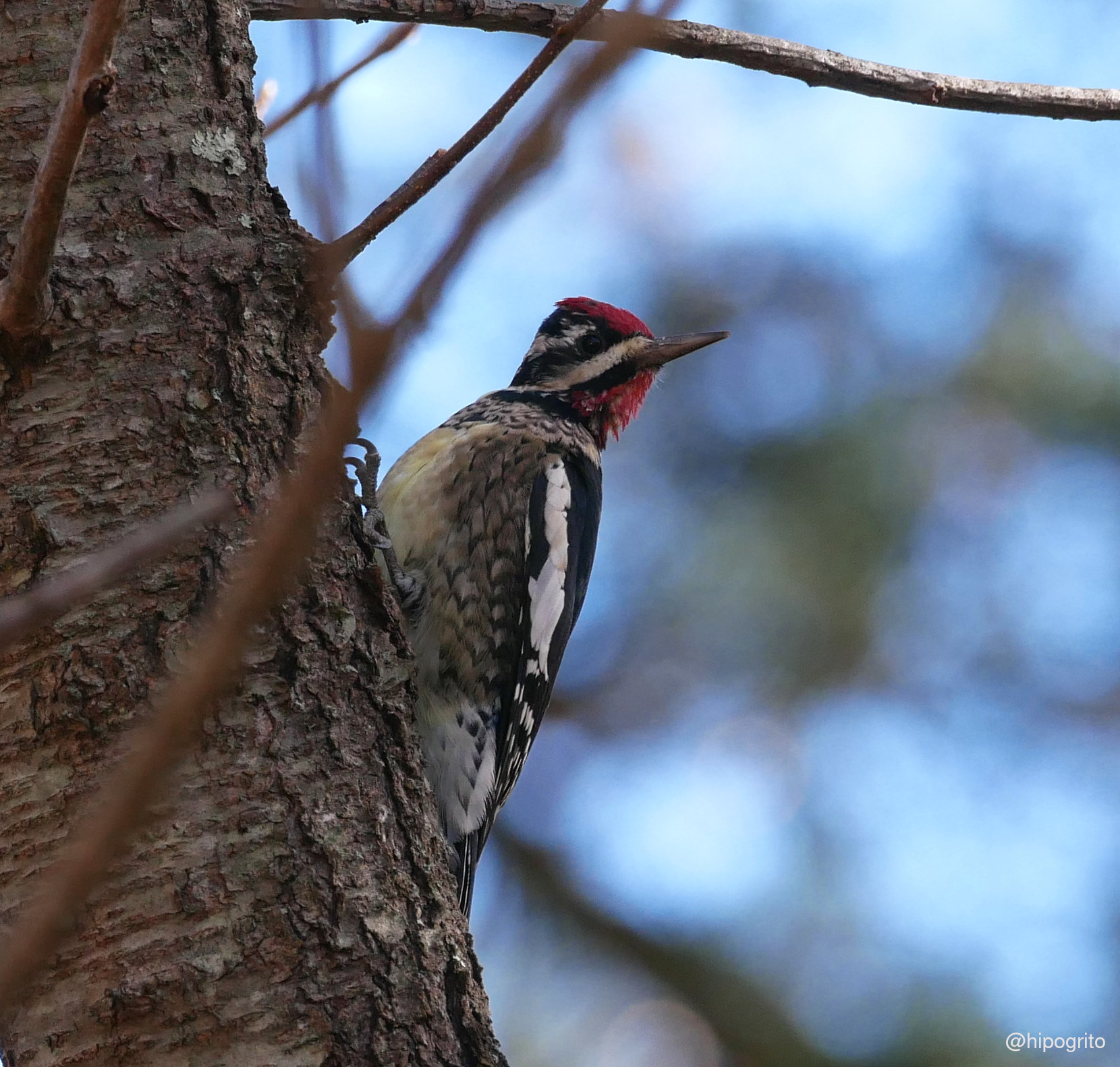
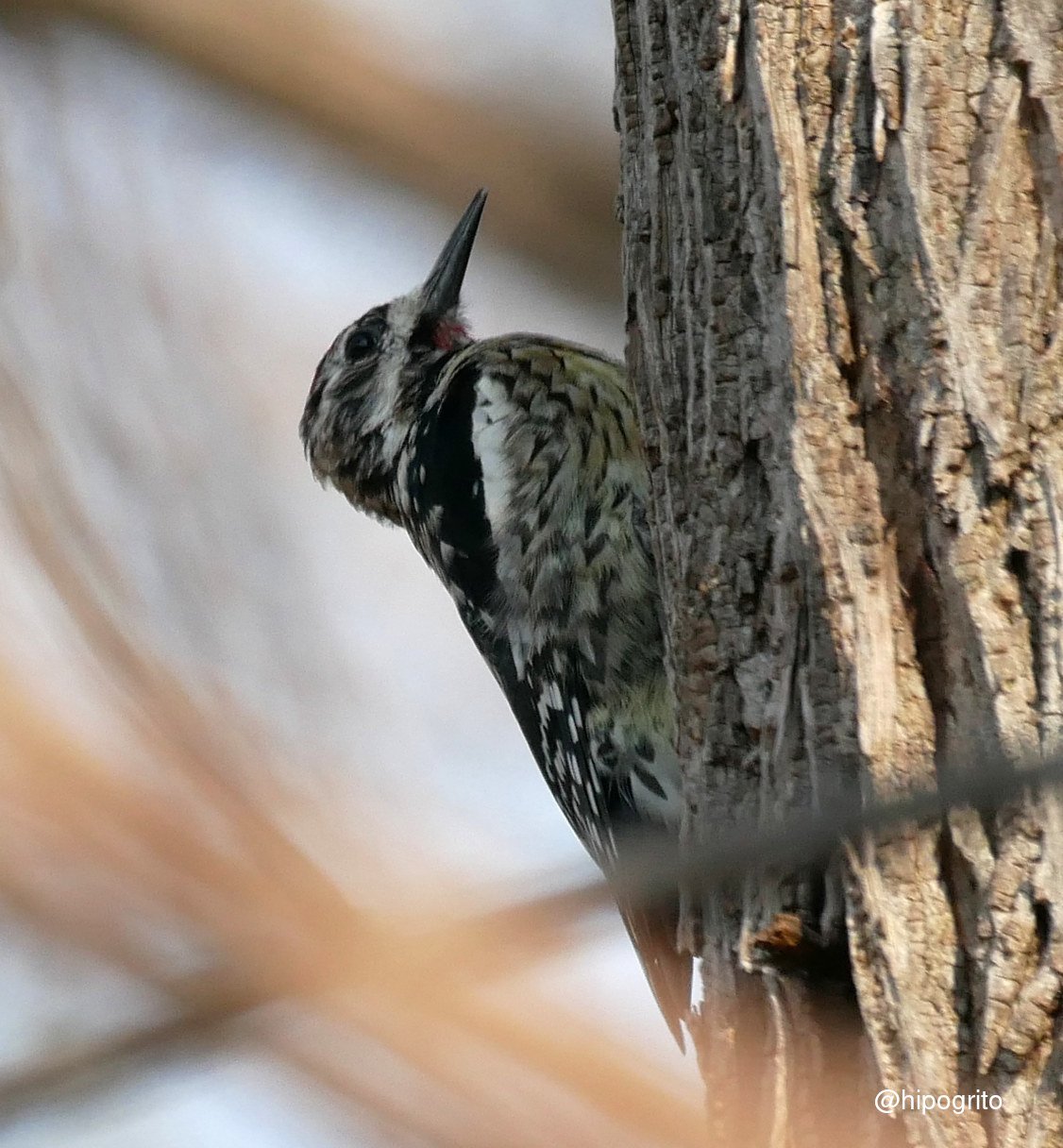
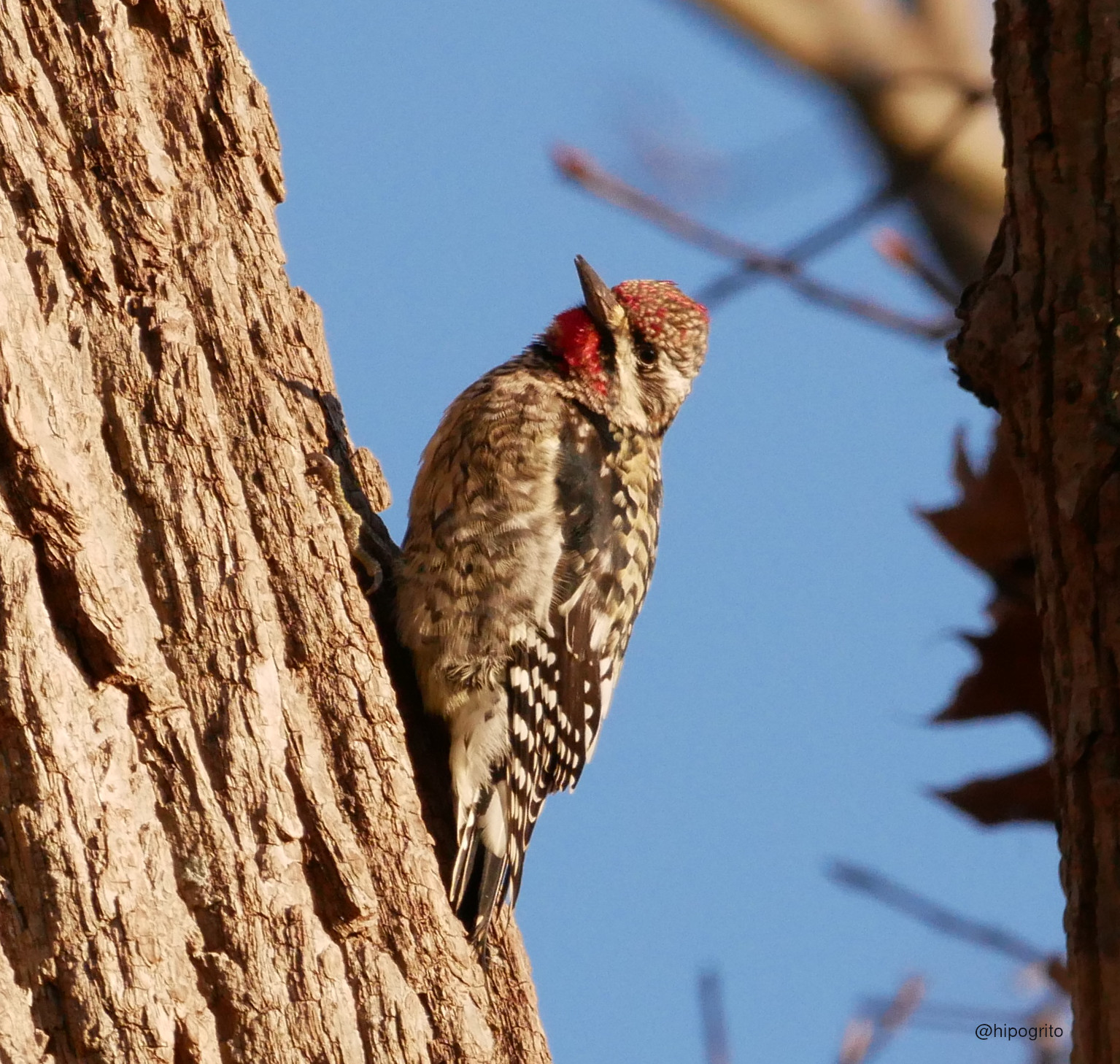
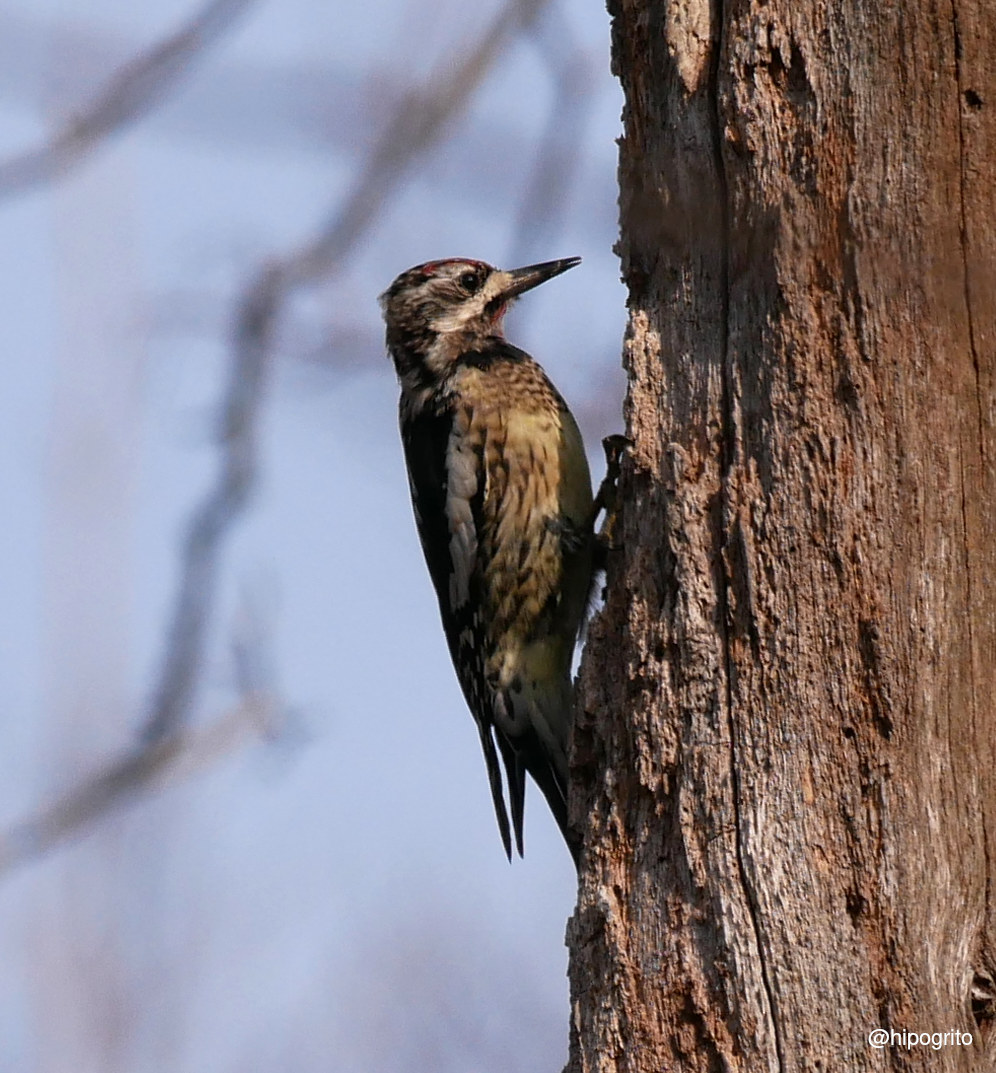
<a id='GBS.PA220.w.3.0.0'></a><p class='gtxt_body' style='text-indent:1em;' id='para.247.3.0.box.167.339.1008.276.q.101'><span style='font-style:italic;font-weight:bold'>Ad. ♂.—</span> Crown and throat crimson, edged with black; line from bill under eye white; back and wings black, everywhere speckled with white; <span style='font-style:italic;'>broad </span><span style='font-style:italic;'>stripe </span><span style='font-style:italic;'>from </span><span style='font-style:italic;'>shoulder </span><span style='font-style:italic;'>along </span><span style='font-style:italic;'>edge </span><span style='font-style:italic;'>of </span><span style='font-style:italic;'>wing </span><span style='font-style:italic;'>white</span><span style='font-style:italic;'>; </span>middle tail-feathers barred with white; upper breast black; belly yellowish. <span style='font-style:italic;font-weight:bold'>Ad. ♀.—</span>  Similar, but throat white. <span style='font-style:italic;font-weight:bold'>Im.— </span>Crown blackish; throat whitish; breast gray, with blackish bars.</p>


<a id='GBS.PA220.w.3.1.0'></a><p class='gtxt_body' style='text-indent:1em;' id='para.247.3.1.box.203.624.592.41.q.101'><span style='font-style:italic;font-weight:bold'>Nest</span>, in a hole in a tree<span style='font-style:italic;'>. </span><span style='font-style:italic;font-weight:bold'>Eggs</span><span style='font-style:italic;'>, </span>white.</p>

<div class="responsive">
  <div class="gallery">
    <a target="_blank" href="../data/yb_ssucker_01.JPG">
     
      <img src='../data/yb_ssucker_01.JPG' style=' ' alt='Yellow-bellied Sapsucker'/>
    </a>
    <div class="desc">Long Island, NY, 2021</div>
  </div>
</div>
<div class="responsive">
  <div class="gallery">
    <a target="_blank" href="../data/yb_ssucker_2022_04.JPG">
     
      <img src='../data/yb_ssucker_2022_04.JPG' style=' ' alt='Yellow-bellied Sapsucker'/>
    </a>
    <div class="desc">Long Island, NY, 2022</div>
  </div>
</div>

<div class="responsive">
  <div class="gallery">
    <a target="_blank" href="../data/yb_ssucker_2022_02.JPG">
     
      <img src='../data/yb_ssucker_2022_02.JPG' style=' ' alt='Yellow-bellied Sapsucker'/>
    </a>
    <div class="desc">Long Island, NY, 2022</div>
  </div>
</div>


<div class="responsive">
  <div class="gallery">
    <a target="_blank" href="../data/yb_ssucker_2022_03.JPG">
     
      <img src='../data/yb_ssucker_2022_03.JPG' style=' ' alt='Yellow-bellied Sapsucker'/>
    </a>
    <div class="desc">Long Island, NY, 2022</div>
  </div>
</div>

<div class="clearfix"></div>

<a id='GBS.PA220.w.4.0.0'></a><p class='gtxt_body' style='text-indent:1em;' id='para.247.4.0.box.167.698.1008.105.q.101'>In the Canadian Zone the Sapsucker is a common summer resident; elsewhere in New England and New York it is a migrant, passing north in April, and returning in late September and early October. It is occasionally found in winter in the lower Hudson Valley. On migration it is found in apple orchards, open groves, and not infrequently on shade trees about the houses. The Sapsucker breeds in Massachusetts only on Mount Greylock, and there but sparingly; but on the upland of Vermont, in northern and central New Hampshire, in the Adirondacks, and in the Maine woods, it breeds commonly.</p>

<div id='block.247.5.0.box.152.840.1024.416.q.101' class='gimg_graphic'>
<img src='../data/content-0168.png' style='max-width:100%; max-height:100%' alt='[graphic][merged small]'/></div>
<a id='GBS.PA220.w.7.1.0'></a><p class='gtxt_body' style='text-indent:1em;' id='para.247.7.1.box.169.1795.998.101.q.101'>Each pair have a “sugar orchard” of maple or birch, to which they resort constantly to drink the sap; in order to obtain it they drill small holes in successive rows, which often completely encircle the tree. Here they may be found 'clinging to the trunk, which is already riddled with holes and perhaps dying. About them fly hummingbirds, bees, and butterflies, attracted by the sweet liquid. For a long time there was doubt as to their object in drilling the holes, many believing it was to attract insects. Mr. Bolles (“Auk," vol. viii. p. 256) has shown that while insects do form a considerable part of their food, their chief object in drilling the holes is to get the sap. They also eat pieces of one of the inner layers of the bark. Nearly every old apple-tree gives evidence in its numerous rings of the visits of the Sapsucker. The young while in the nest are fed on insects, which the Sapsuckers often take on the wing.</p>
<a id='GBS.PA221.w.2.1.0'></a><p class='gtxt_body' style='text-indent:1em;' id='para.248.2.1.box.232.914.1000.572.q.101'>On the breeding ground the Sapsucker is noisy, uttering a squealing cry like a Jay's or Red-shouldered Hawk's, but more subdued; it also drums on resonant bark loud enough to be heard at a considerable distance. While migrating however it rarely utters a sound, and it is only when the eye catches sight of its rather stout body, pitching from one tree to the trunk of the next, that attention is called to it. If it is an adult, the crimson crown extending over the forehead serves to identify it. The speckled back and the <span style='font-style:italic;'>stripe </span><span style='font-style:italic;'>of </span><span style='font-style:italic;'>white </span><span style='font-style:italic;'>which </span><span style='font-style:italic;'>shows </span><span style='font-style:italic;'>along </span><span style='font-style:italic;'>the </span><span style='font-style:italic;'>black </span><span style='font-style:italic;'>wing</span><span style='font-style:italic;'>, </span>even when the wing is closed, serve to distinguish the young bird.</p>
</div>

<div id='block.248.4.0.box.290.1523.701.92.q.101' class='gtxt_body' style='margin-bottom: 1.5em;'>
<a id='GBS.PA221.w.4.0.0'></a><p class='gtxt_h3_heading' style='text-indent:1em;text-align:center' id='american_three_toed'><a href="toc.xml#toc_american_three_toed">AMERICAN THREE-TOED WOODPECKER</a>. <span style='font-style:italic;'>Picoides americanus [dorsalis] </span><br/>8.75 in.</p>

<a id='GBS.PA221.w.6.0.0'></a><p class='gtxt_body' style='text-indent:1em;' id='para.248.6.0.box.232.1684.1001.165.q.101'><span style='font-style:italic;font-weight:bold'>Ad. ♂.—</span> Similar to the following species, except the top of the head, which is more or less mixed with white, and the back, which is <span style='font-style:italic;'>crossed </span><span style='font-style:italic;'>by </span><span style='font-style:italic;'>narrow </span><span style='font-style:italic;'>white </span><span style='font-style:italic;'>bars</span><span style='font-style:italic;'>. </span><span style='font-style:italic;font-weight:bold'>Ad.♀.—</span> Similar to ♂, but without the yellow crown-patch.</p>
<a id='GBS.PA221.w.6.1.0'></a><p class='gtxt_body' style='text-indent:1em;' id='para.248.6.1.box.268.1845.579.41.q.101'><span style='font-style:italic;font-weight:bold'>Nest</span><span style='font-style:italic;'>, </span>in a hole in a tree<span style='font-style:italic;'>. </span><span style='font-style:italic;font-weight:bold'>Eggs</span><span style='font-style:italic;'>, </span>white.</p>

<a id='GBS.PA222.w.1.0.0'></a><p class='gtxt_body' style='text-indent:1em;' id='para.249.1.0.box.158.167.1005.296.q.101'>The American Three-toed Woodpecker “has practically the same range in New England as the following species, but it is in most places very much less numerous. Among the White Mountains, however, and about the sources of the Connecticut River, it is not so very uncommon for a bird of its solitary and retiring disposition ” (Brewster).</p>
<a id='GBS.PA222.w.1.1.0'></a><p class='gtxt_body' style='text-indent:1em;' id='para.249.1.1.box.156.465.1006.143.q.101'>This species occurs south of its breeding-range far less often than the following, from which it may be distinguished by the narrow <span style='font-style:italic;'>bars </span><span style='font-style:italic;'>of </span><span style='font-style:italic;'>white </span><span style='font-style:italic;'>across </span>its back.</p>
</div>
<div id='block.249.2.0.box.172.657.974.39.q.101' class='gtxt_body' style='margin-bottom: 1.5em;'>
<a id='GBS.PA222.w.2.0.0'></a><p class='gtxt_h3_heading' style='text-indent:1em;text-align:center' id='artic_three_toed'><a href="toc.xml#toc_artic_three_toed">ARCTIC THREE-TOED [BLACK-BACKED] WOODPECKER</a>. <span style='font-style:italic;'>Picoides arcticus </span><br/>9.50 in.</p>
</div>
<div id='block.249.4.0.box.156.772.1006.241.q.101' class='gtxt_body' style='margin-bottom: 1.5em;'>
<a id='GBS.PA222.w.4.0.0'></a><p class='gtxt_body' style='text-indent:1em;' id='para.249.4.0.box.156.772.1006.203.q.101'><span style='font-style:italic;font-weight:bold'>Ad. ♂.—</span> Top of head black, with yellow crown-patch; <span style='font-style:italic;'>back </span><span style='font-style:italic;'>black</span><span style='font-style:italic;'>; </span>stripe on side of bead white, bordered beneath by a black line; wings black, spotted with white; middle tail-feathers black, the outer feathers white. <span style='font-style:italic;font-weight:bold'>Ad. ♀.—</span> Similar, but without the yellow crown-patch.</p>
<a id='GBS.PA222.w.4.1.0'></a><p class='gtxt_body' style='text-indent:1em;' id='para.249.4.1.box.193.973.596.40.q.101'><span style='font-style:italic;font-weight:bold'>Nest</span>, in a hole in a tree. <span style='font-style:italic;font-weight:bold'>Eggs</span><span style='font-style:italic;'>, </span>white.</p>

<a id='GBS.PA222.w.5.0.0'></a><p class='gtxt_body' style='text-indent:1em;' id='para.249.5.0.box.202.1049.637.48.q.101'>The Arctic Three-toed Woodpecker is a rather common but somewhat local resident of the wilder and more heavily timbered portions of northern New England, whence it sometimes wanders southwards in autumn and winter (Brewster). It is rare south of the White Mountains, the Adirondacks, and the forests of Maine, though stragglers are occasionally found in autumn and winter as far south as Connecticut. Its notes are loud and shrill, and are often uttered as the bird flies.</p>
<a id='GBS.PA222.w.5.2.0'></a><p class='gtxt_body' style='text-indent:1em;' id='para.249.5.2.box.158.1492.1007.388.q.101'>The <span style='font-style:italic;'>plain </span><span style='font-style:italic;'>black </span><span style='font-style:italic;'>back </span>serves to distinguish it from any other small woodpecker. The white <span style='font-style:italic;'>stripe </span>on the side of the head is also a help to identification, the corresponding mark on the American Three-toed Woodpecker being a mere <span style='font-style:italic;'>line</span><span style='font-style:italic;'>. </span>Mrs. Eckstorm, in “ The Woodpeckers,” says that she has found this to be the best field-mark of this species. Adult <span style='font-style:italic;'>males </span>of both this species and the preceding have conspicuous <span style='font-style:italic;'>yellow </span>patches on the <span style='font-style:italic;'>crown</span><span style='font-style:italic;'>. </span></p>
</div>
</div>
<br/>
<div class='flow' style=''>
<a class='page' id='GBS.PA223'></a>
<div id='block.250.2.0.box.224.178.1003.428.q.101' class='gtxt_body' style='margin-bottom: 1.5em;'>
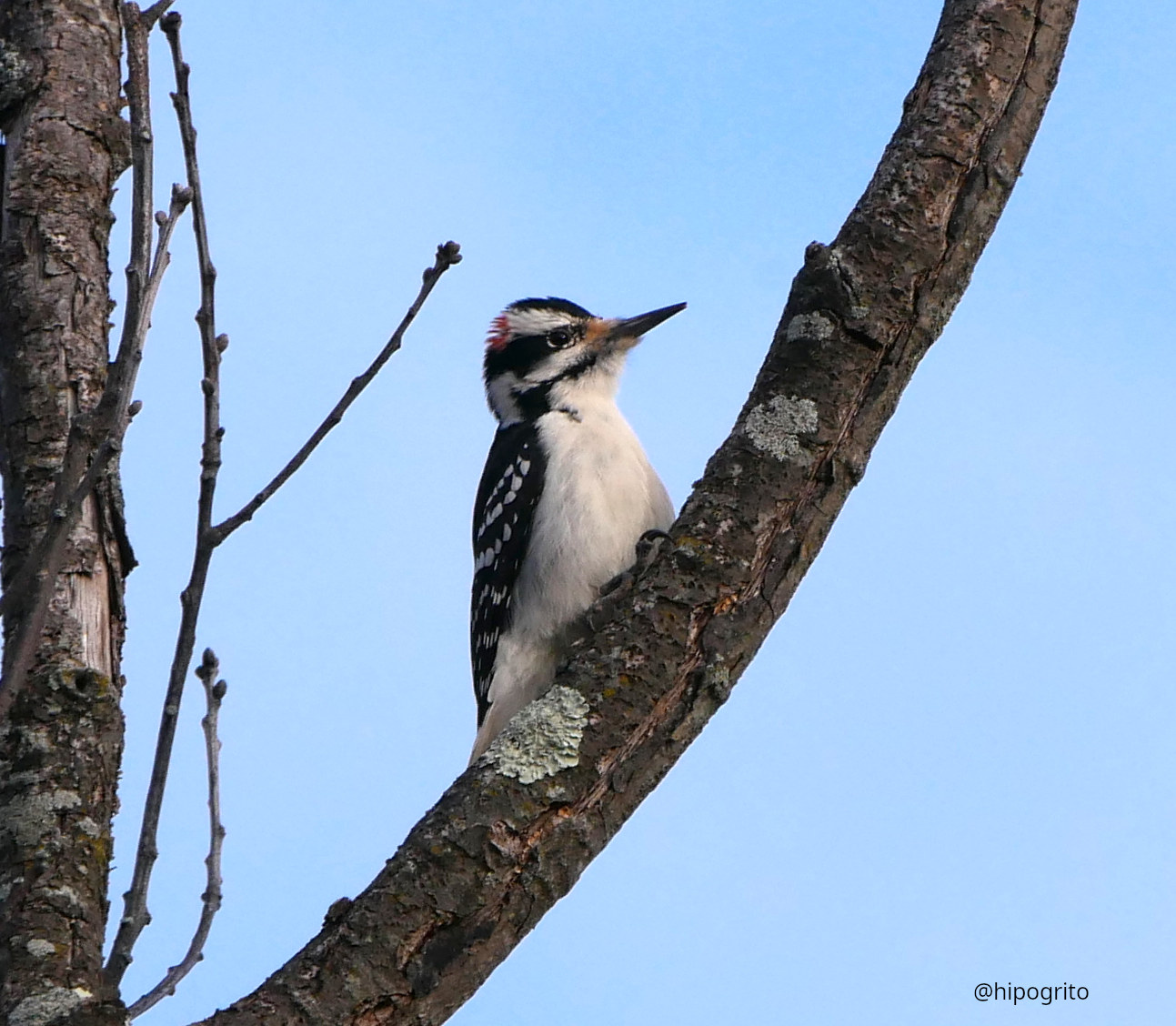
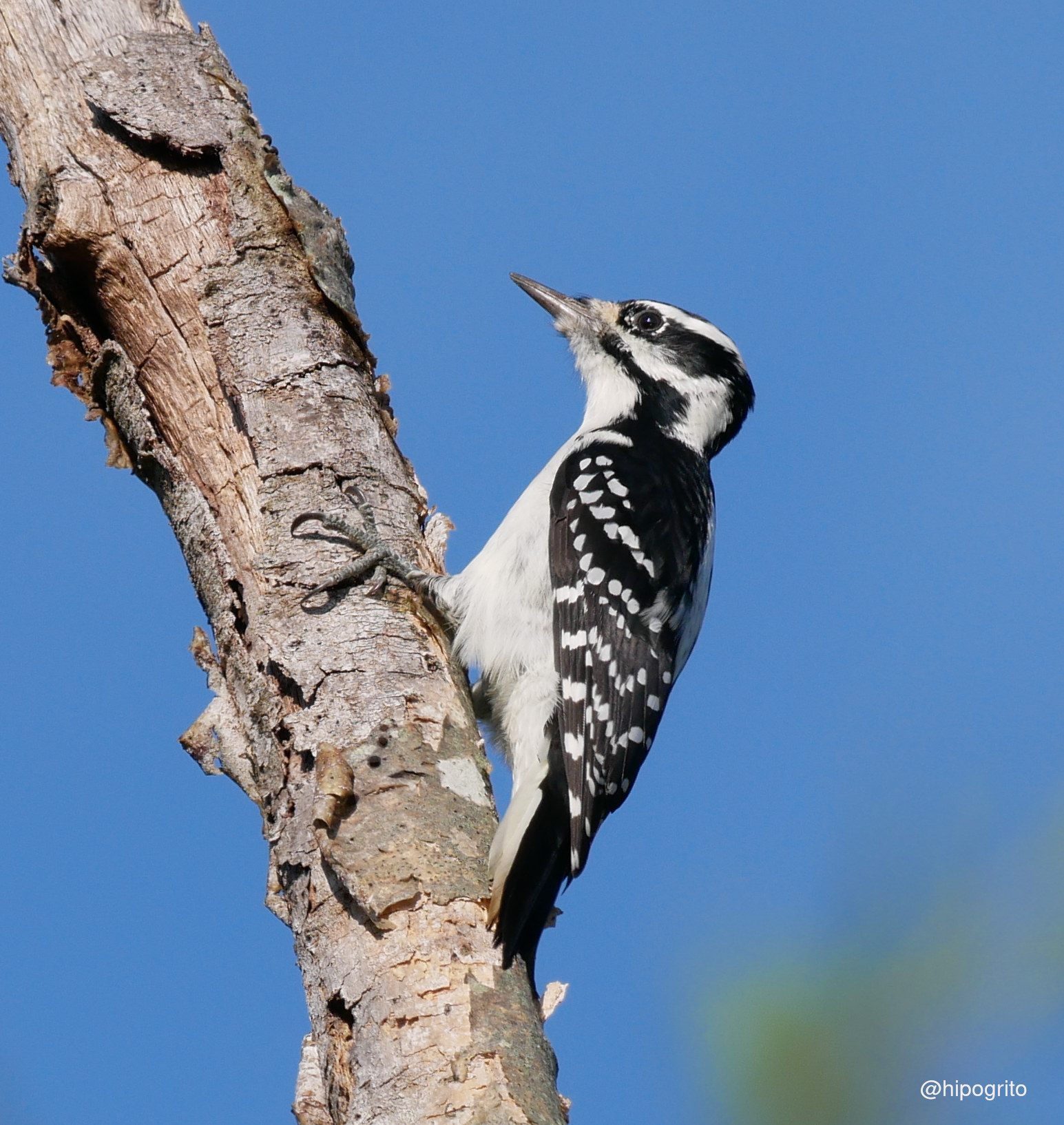
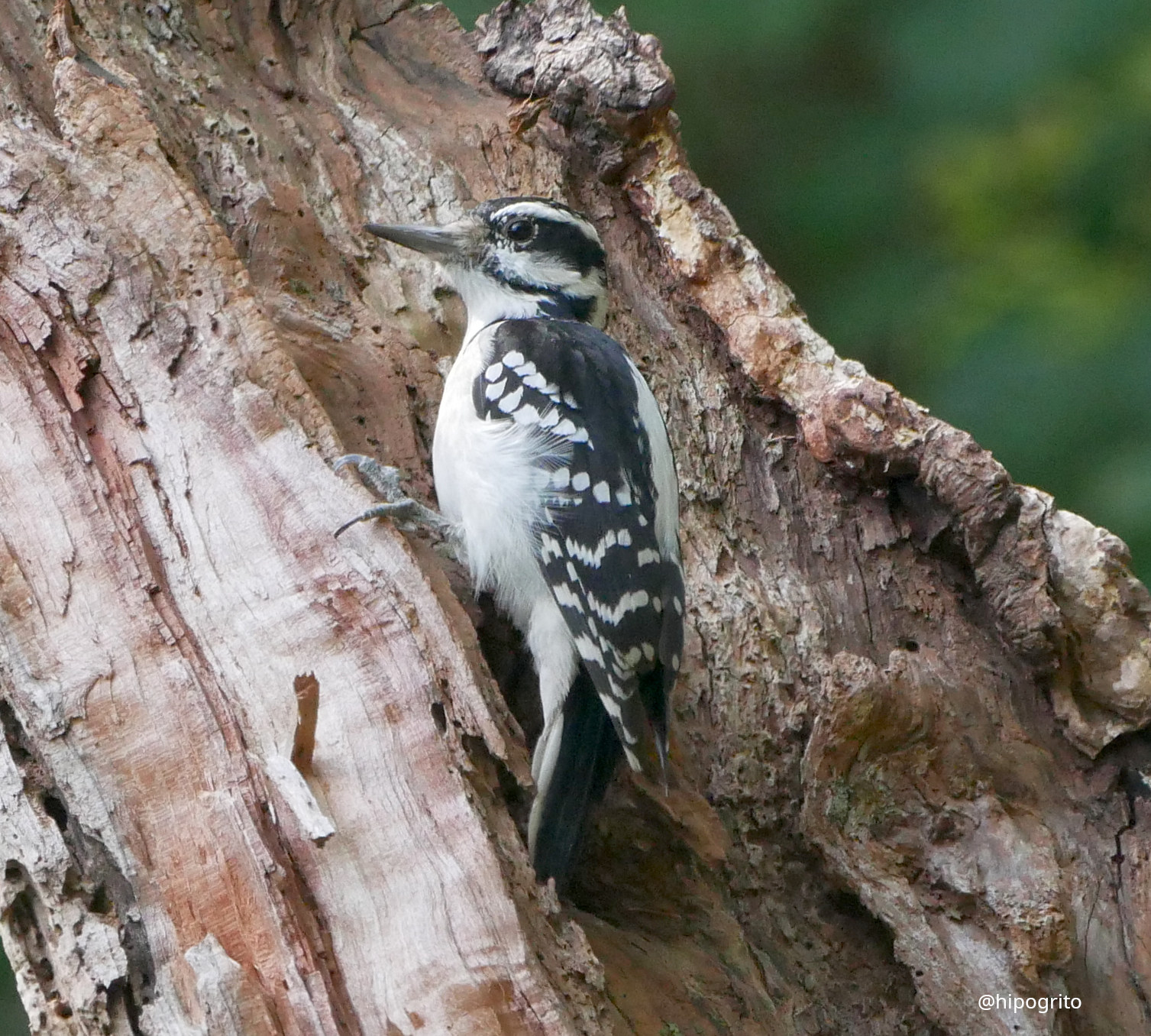
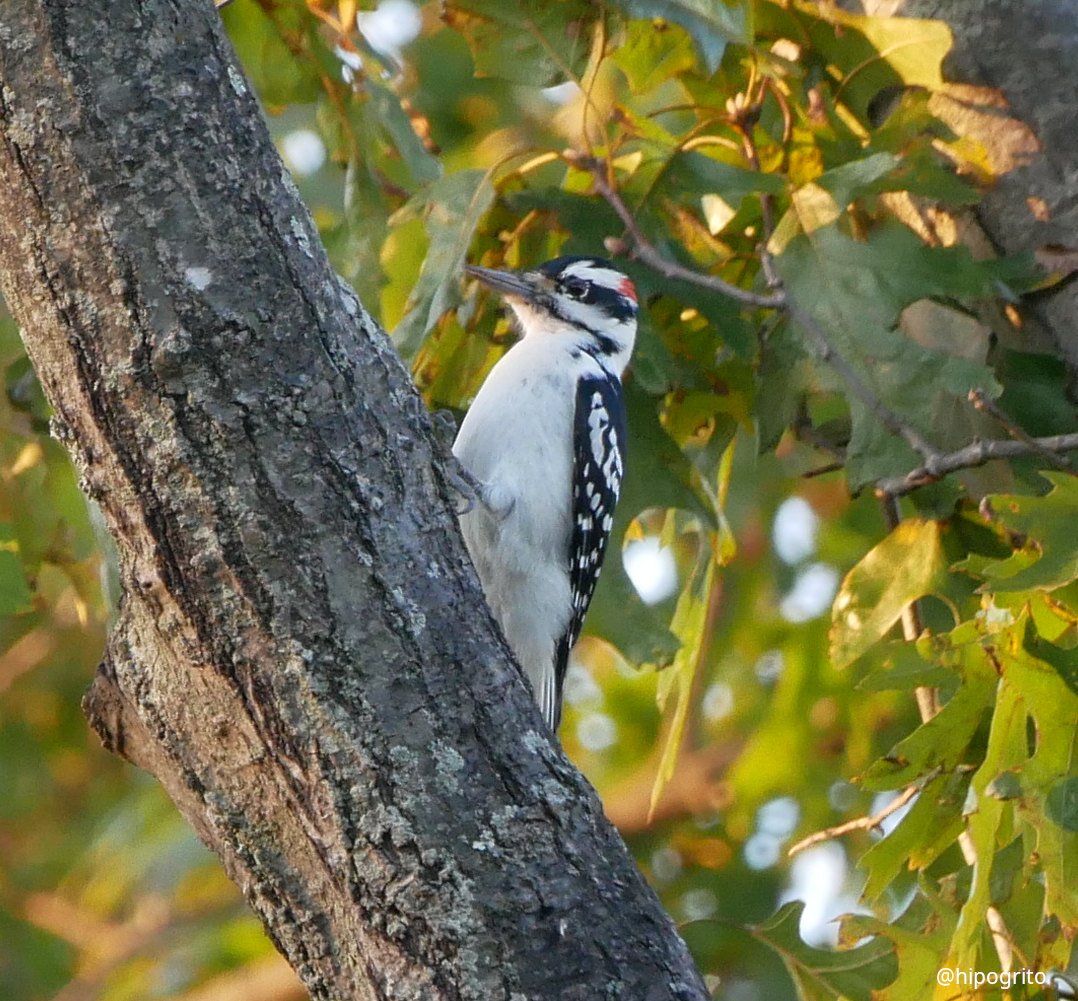
<a id='GBS.PA223.w.2.0.0'></a><p class='gtxt_h3_heading' style='text-indent:1em;text-align:center' id='downy'><a href="toc.xml#toc_downy">DOWNY WOODPECKER</a>. <span style='font-style:italic;'>Dryobates [Picoides] pubescens medianus </span><br/>6.83 in.</p>
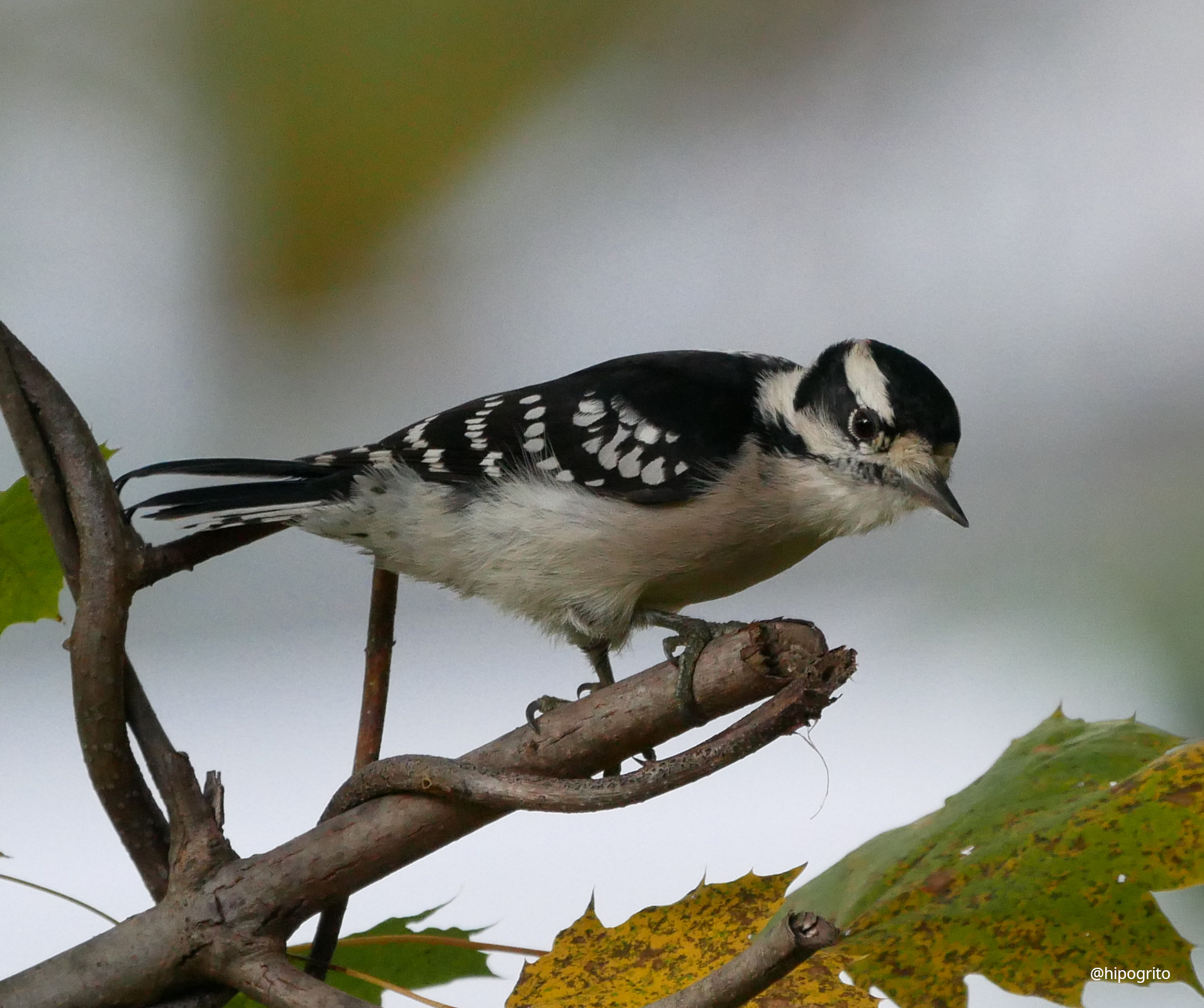
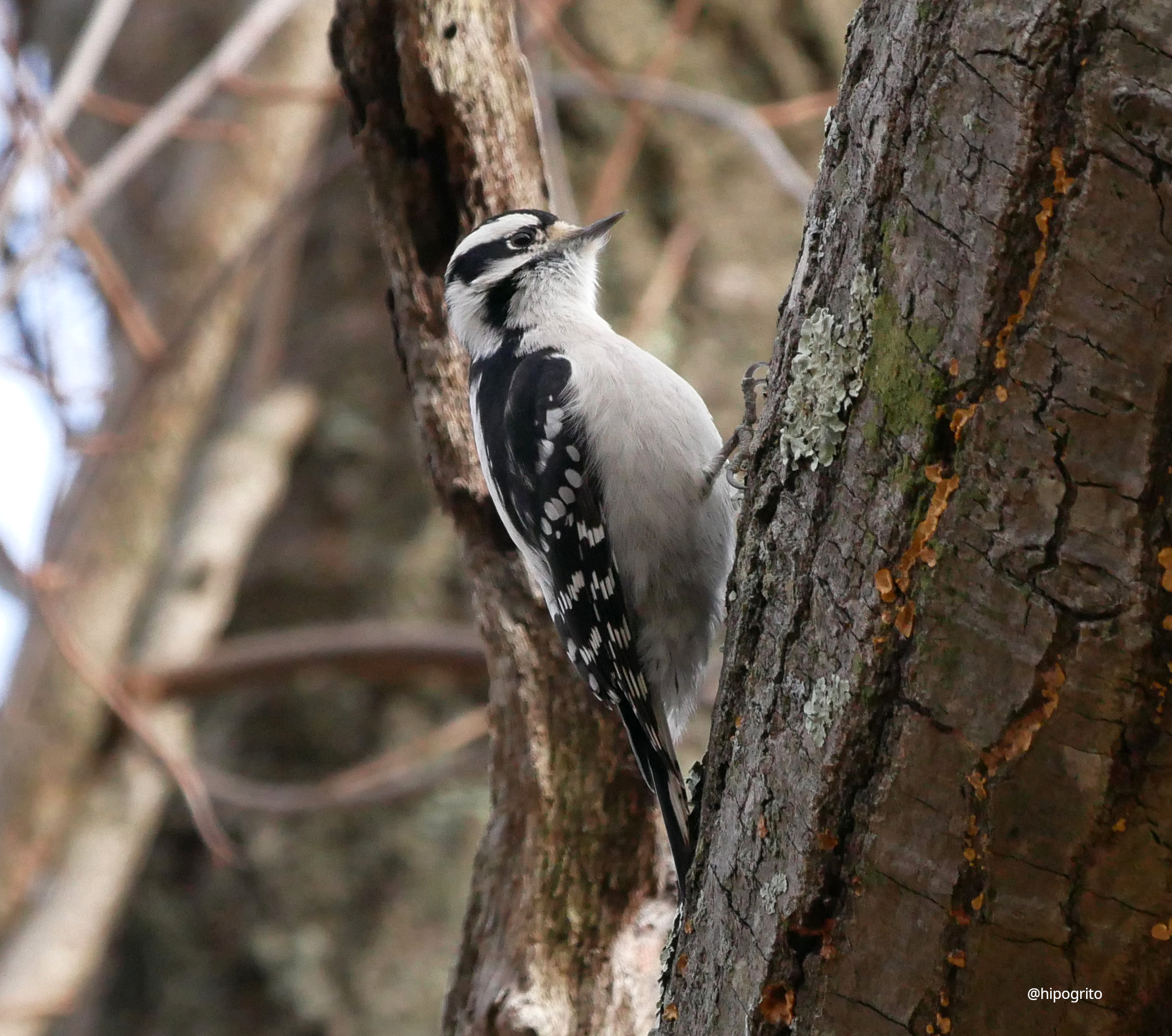
<a id='GBS.PA223.w.2.1.0'></a><p class='gtxt_body' style='text-indent:1em;' id='para.250.2.1.box.259.240.567.88.q.101'><span style='font-style:italic;font-weight:bold'>Ad. ♂.—</span> Upper parts black; stripe above and below eye, <span style='font-style:italic;'>middle </span><span style='font-style:italic;'>of </span><span style='font-style:italic;'>back</span><span style='font-style:italic;'>, </span>and bars across the wing <span style='font-style:italic;'>white</span><span style='font-style:italic;'>; </span>outer tail-feathers white, barred with black; under parts white; a. scarlet patch at the back of the head. <span style='font-style:italic;font-weight:bold'>Ad.♀.—</span> Similar, without the scarlet patch. <span style='font-style:italic;font-weight:bold'>Im.—</span> Young males in summer have a reddish brown patch at the back of the head.</p>


<a id='GBS.PA223.w.2.3.0'></a><p class='gtxt_body' style='text-indent:1em;' id='para.250.2.3.box.226.531.999.75.q.101'><span style='font-style:italic;font-weight:bold'>Nest</span><span style='font-style:italic;'>, </span>in a hole in a dead limb, from ten to thirty feet up. <span style='font-style:italic;font-weight:bold'>Eggs</span><span style='font-style:italic;'>, </span>white.</p>

<div class="responsive">
  <div class="gallery">
    <a target="_blank" href="../data/downy_05_crop.JPG">
     
      <img src='../data/downy_05_crop.JPG' style=' ' alt='Downy Woodpecker'/>
    </a>
    <div class="desc">Long Island, NY, 2021</div>
  </div>
</div>

<div class="responsive">
  <div class="gallery">
    <a target="_blank" href="../data/downy_2022_04.JPG">
     
      <img src='../data/downy_2022_04.JPG' style=' ' alt='Downy Woodpecker'/>
    </a>
    <div class="desc">Long Island, NY, 2022</div>
  </div>
</div>


<div class="responsive">
  <div class="gallery">
    <a target="_blank" href="../data/downy_2022_w02.JPG">
     
      <img src='../data/downy_2022_w02.JPG' style=' ' alt='Downy Woodpecker'/>
    </a>
    <div class="desc">Long Island, NY, 2022</div>
  </div>
</div>


<div class="responsive">
  <div class="gallery">
    <a target="_blank" href="../data/downy_2022_w04.JPG">
     
      <img src='../data/downy_2022_w04.JPG' style=' ' alt='Downy Woodpecker'/>
    </a>
    <div class="desc">Northport, Long Island, NY, 2022</div>
  </div>
</div>


<div class="clearfix"></div>

<a id='GBS.PA223.w.3.0.0'></a><p class='gtxt_body' style='text-indent:1em;' id='para.250.3.0.box.224.666.1004.377.q.101'>The Downy Woodpecker is a common permanent resident of New England and New York. It frequents woodland, orchards, and shade trees. In winter it often follows a wandering band of Chickadees, and may easily be attracted to a bone or piece of suet hung on a limb near the house. Occasionally in spring one sees a Downy flying through the trees as if crazy, or two sometimes have a wild chase in and out of the tree trunks.</p>


<a id='GBS.PA223.w.3.1.0'></a><p class='gtxt_body' style='text-indent:1em;' id='para.250.3.1.box.225.1054.1001.378.q.101'>In March the male begins to drum on some dry resonant limb, and by May the pair have excavated a nesting-hole in a dead limb in some woodland tree. The call-note of the Downy is a sharp <span style='font-style:italic;'>chick</span><span style='font-style:italic;'>, </span>and it also gives, less frequently, a shrill cry with a rapid downward fall, suggesting in form the whinny of a horse. The young, when following the parents, have a shrill whinnying cry like the adults, but with less downward inflection.</p>
<a id='GBS.PA223.w.3.2.0'></a><p class='gtxt_body' style='text-indent:1em;' id='para.250.3.2.box.226.1444.1003.438.q.101'>The attitude of the Downy, when climbing the trunk or large limb of a tree, distinguishes it readily from the smaller <a href="warblers2.xml#black_and_white_warbler">Black and White Warbler</a>. It is always erect, parallel, that is, with the limb, sometimes above a horizontal limb, sometimes on the under side, but never peering over each side as the Warbler does. Its progress is by jerks; it often backs down, tail first, but never comes down head first, like the Nuthatch. Occasionally it perches like a song-bird across a small twig. (See, also, following species.)</p>

</div>


<div id='block.251.1.0.box.173.164.1008.1138.q.101' class='gtxt_body' style='margin-bottom: 1.5em;'>
<a id='GBS.PA224.w.1.0.0'></a><p class='gtxt_h3_heading' style='text-indent:1em;text-align:center' id='hairy'><a href="toc.xml#toc_hairy">HAIRY WOODPECKER</a><span style='font-style:italic;'>. </span><span style='font-style:italic;'>Dryobates [Leuconotopicus] villosus</span><br/>9.40 in. Bill 1.22 in.</p>


<a id='GBS.PA224.w.1.1.0'></a><p class='gtxt_body' style='text-indent:1em;' id='para.251.1.1.box.175.229.1004.173.q.101'><span style='font-style:italic;font-weight:bold'>Ad.—</span> Similar to the Downy Woodpecker, but larger, the outer tail-feathers pure white, not barred with black.
</p>
<p class='gtxt_body' style='text-indent:1em;' id='para.251.1.1.box.175.229.1004.173.q.101'>
 <span style='font-style:italic;font-weight:bold'>Nest</span><span style='font-style:italic;'>, </span>in a hole in a tree<span style='font-style:italic;'>. </span><span style='font-style:italic;font-weight:bold'>Eggs</span><span style='font-style:italic;'>, </span>white.</p>

<div class="responsive">
  <div class="gallery">
    <a target="_blank" href="../data/hairy_2022_w03.JPG">
     
      <img src='../data/hairy_2022_w03.JPG' style=' ' alt='Hairy Woodpecker'/>
    </a>
    <div class="desc">Northport, Long Island, NY, 2022</div>
  </div>
</div>

<div class="responsive">
  <div class="gallery">
    <a target="_blank" href="../data/hairy_01.JPG">
     
      <img src='../data/hairy_01.JPG' style=' ' alt='Hairy Woodpecker'/>
    </a>
    <div class="desc">Long Island, NY, 2021</div>
  </div>
</div>


<div class="responsive">
  <div class="gallery">
    <a target="_blank" href="../data/hairy_2022_w01.JPG">
     
      <img src='../data/hairy_2022_w01.JPG' style=' ' alt='Hairy Woodpecker'/>
    </a>
    <div class="desc">Long Island, NY, 2022</div>
  </div>
</div>


<div class="responsive">
  <div class="gallery">
    <a target="_blank" href="../data/hairy_2022_w02_possible.JPG">
     
      <img src='../data/hairy_2022_w02_possible.JPG' style=' ' alt='Hairy Woodpecker'/>
    </a>
    <div class="desc">Long Island, NY, 2022</div>
  </div>
</div>


<div class="clearfix"></div>

<a id='GBS.PA224.w.1.2.0'></a><p class='gtxt_body' style='text-indent:1em;' id='para.251.1.2.box.174.426.1007.334.q.101'>The Hairy Woodpecker is a permanent resident of New England and New York, but is much rarer than the Downy in more cultivated districts. Where there is considerable woodland, especially good-sized timber, it is fairly common. In the breeding season it is rarely seen out of the woods, but in fall and winter it wanders about, and not infrequently comes to suet or bones hung out in village yards.</p>


<a id='GBS.PA224.w.1.3.0'></a><p class='gtxt_body' style='text-indent:1em;' id='para.251.1.3.box.173.765.1004.199.q.101'>The <span style='font-style:italic;'>chink </span>of the Hairy is like that of the <a href="#downy">Downy</a>, but to a trained ear it sounds heavier and wilder. Its rattling call lacks the downward run so characteristic of the Downy and suggests the rattle of a Kingfisher.</p>
<a id='GBS.PA224.w.1.4.0'></a><p class='gtxt_body' style='text-indent:1em;' id='para.251.1.4.box.174.961.1004.341.q.101'>If one is in doubt about a woodpecker, the bird is probably the Downy rather than the Hairy, for when the larger bird is seen its size attracts notice at once; it is nearly as large as a Robin, and its bill looks long and heavy. The outer tail-feathers are pure white, not barred with black as in the Downy; but this difference is of little help, unless the bird is seen near at hand, and with outspread tail.</p>
</div>
<br/><br/>
<div id='block.251.1.0.box.173.164.1008.1138.q.101' class='gtxt_body' style='margin-bottom: 1.5em;'>
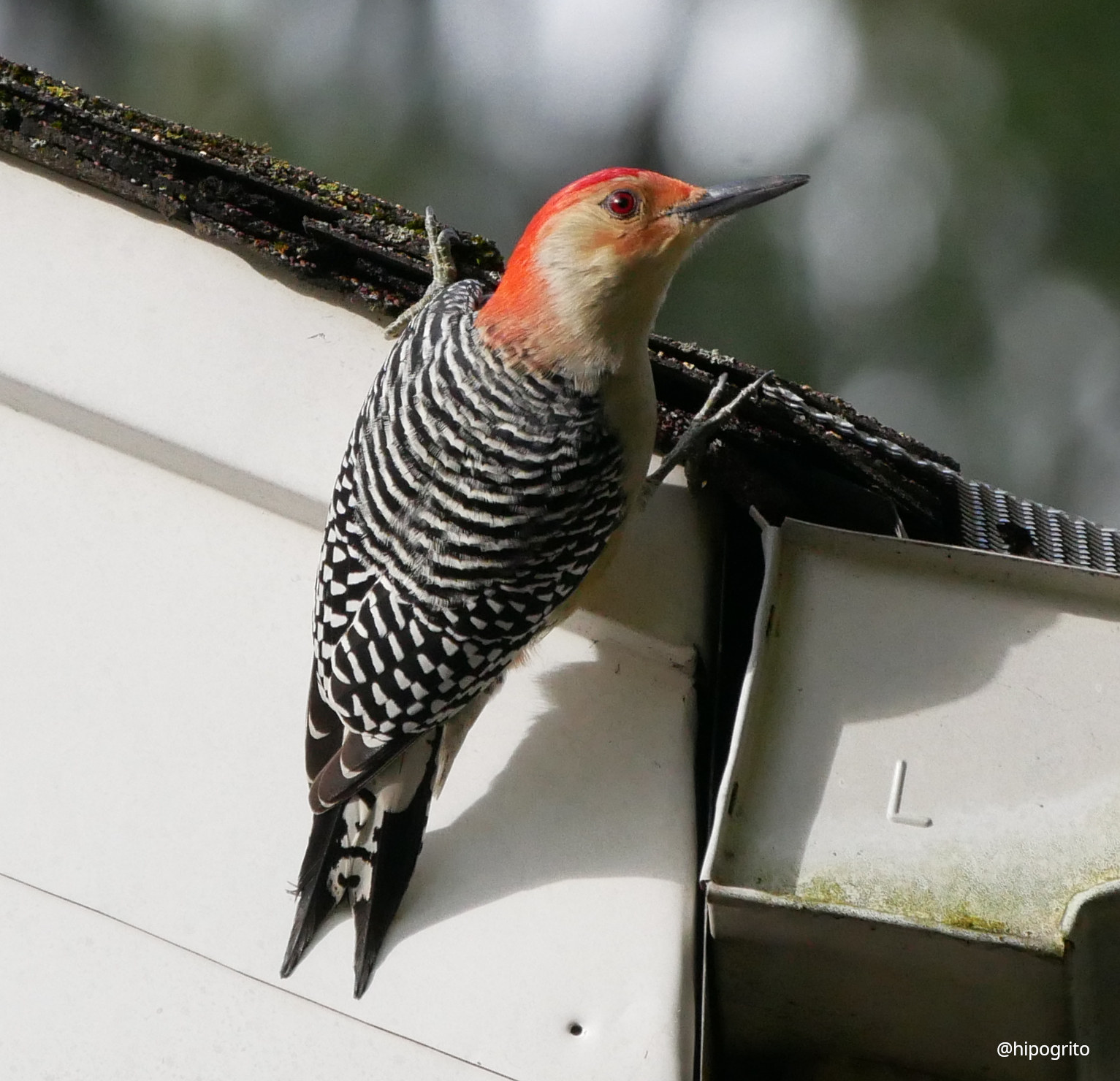
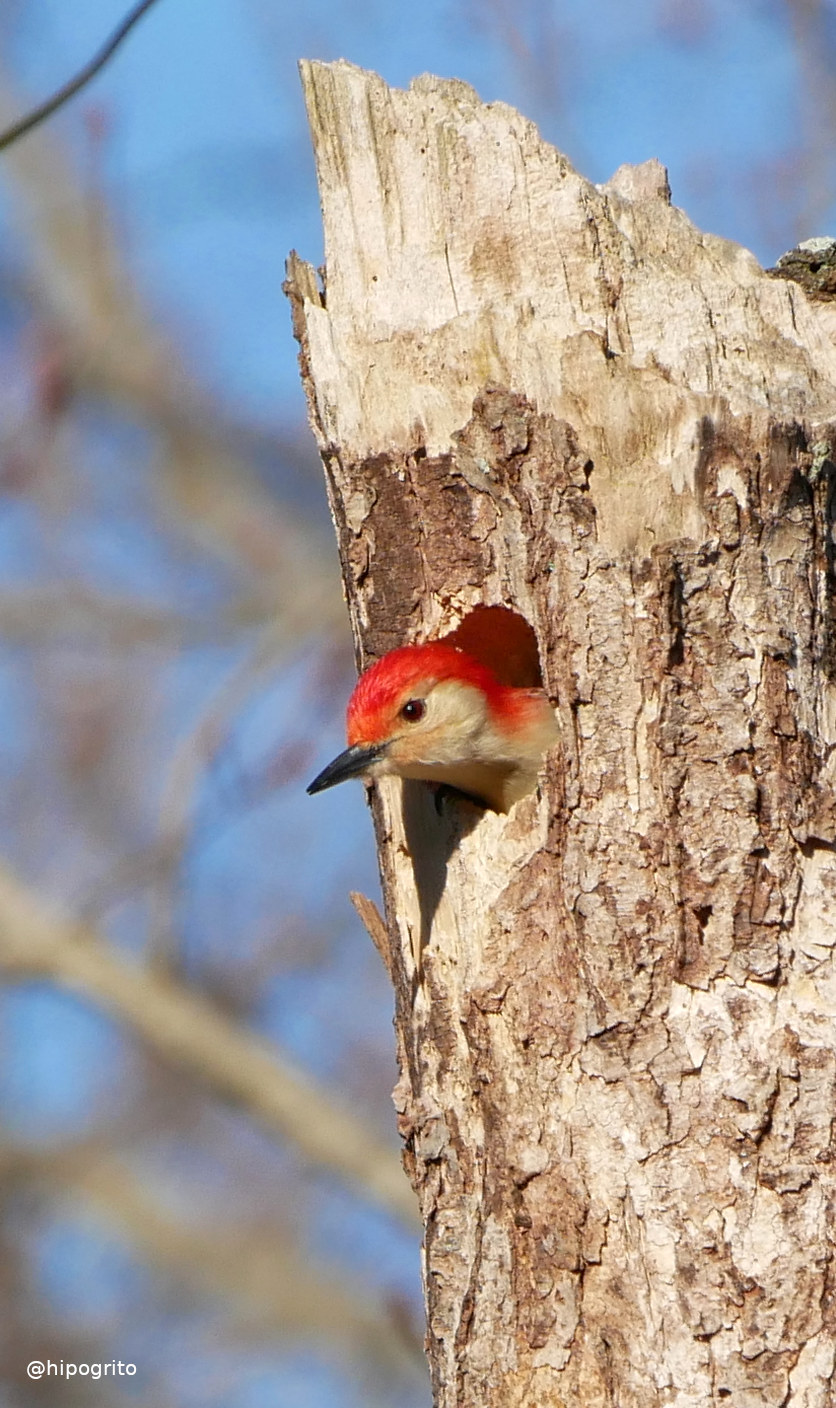
<a id='GBS.PA224.w.1.0.0'></a><p class='gtxt_h3_heading' style='text-indent:1em;text-align:center' id='red_bellied_woodpecker'><a href="toc.xml#toc_red_bellied_woodpecker">[RED-BELLIED WOODPECKER]</a><span style='font-style:italic;'>. </span><span style='font-style:italic;'>Melanerpes </span><span style='font-style:italic;'>carolinus </span></p>
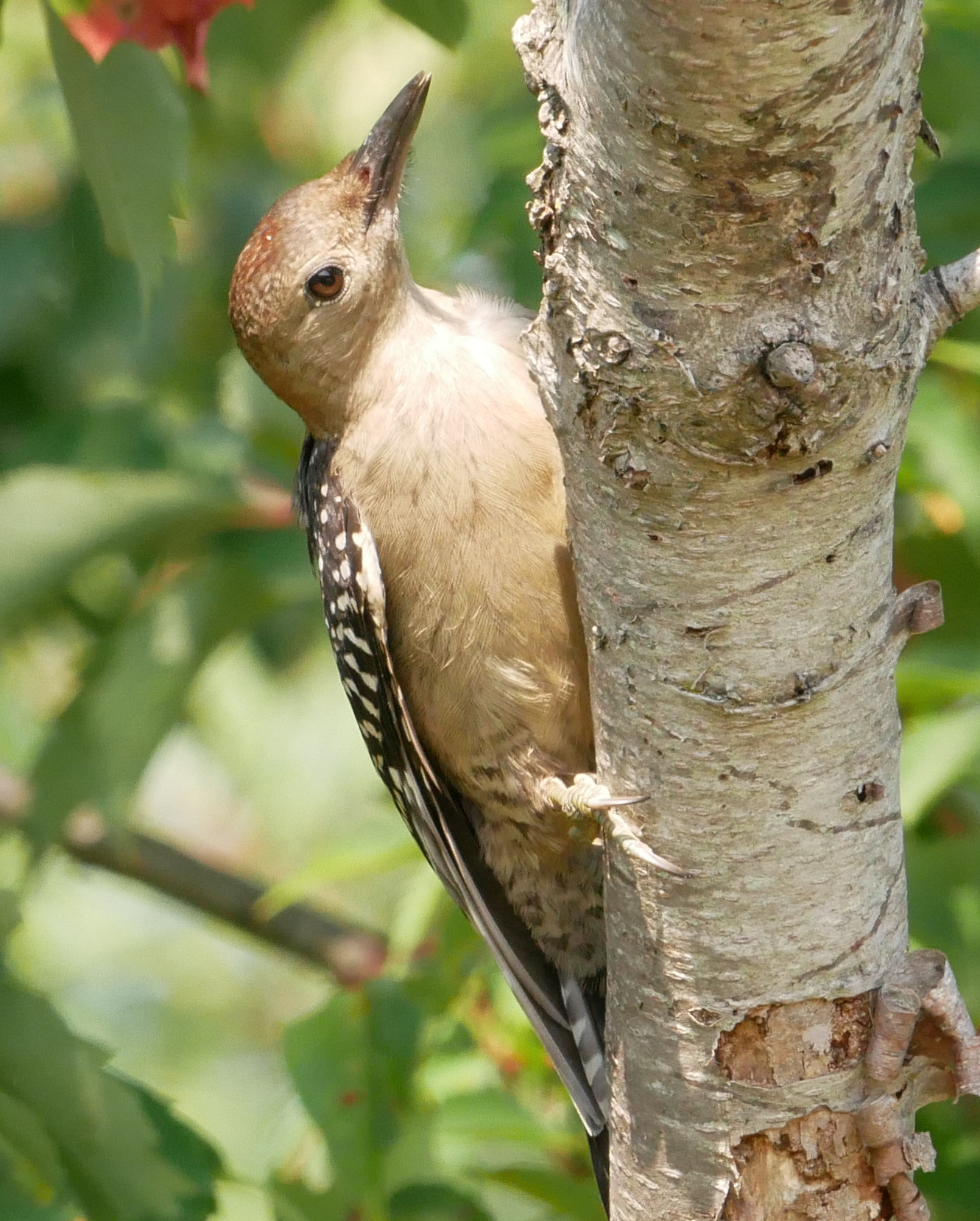
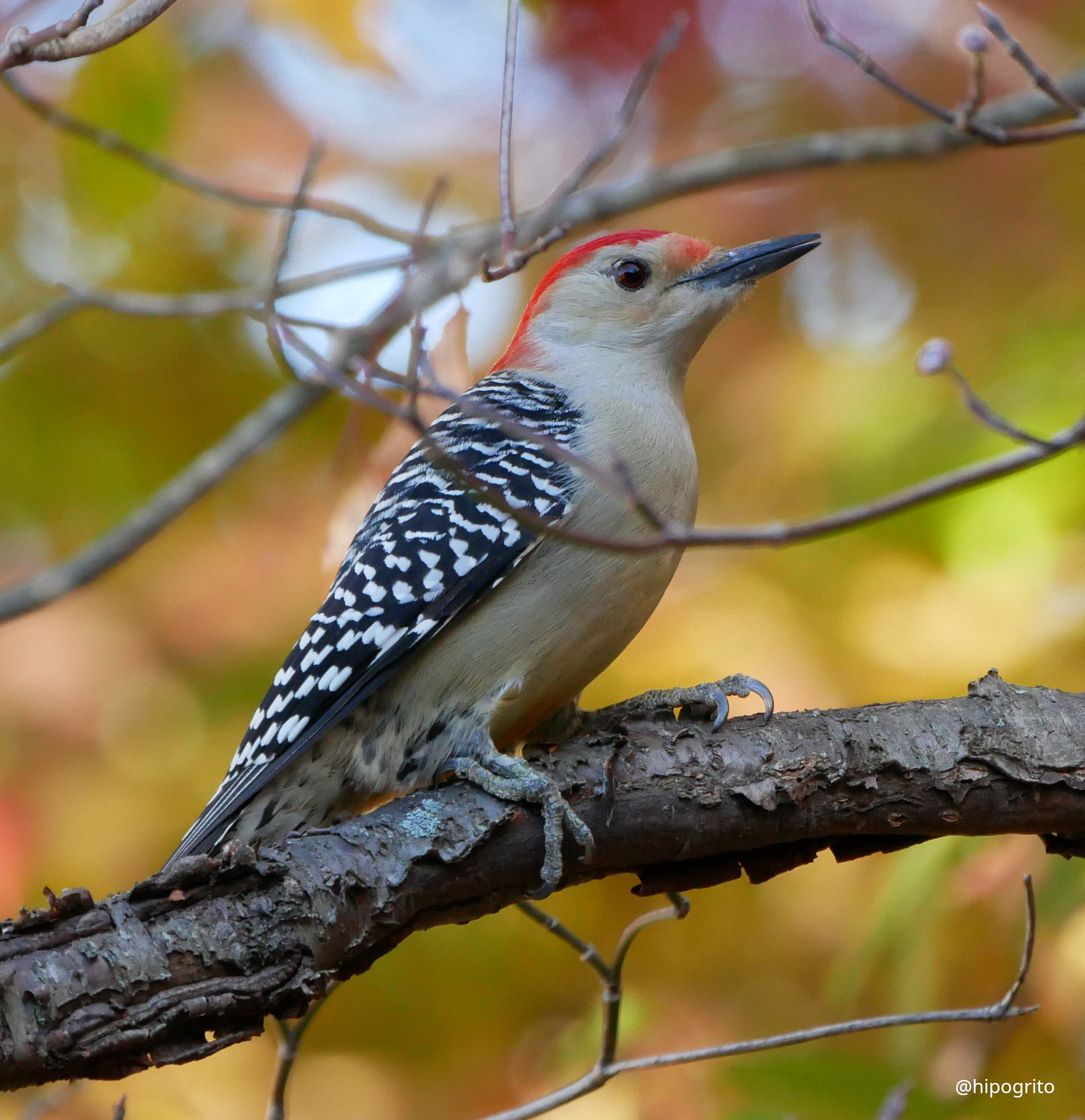
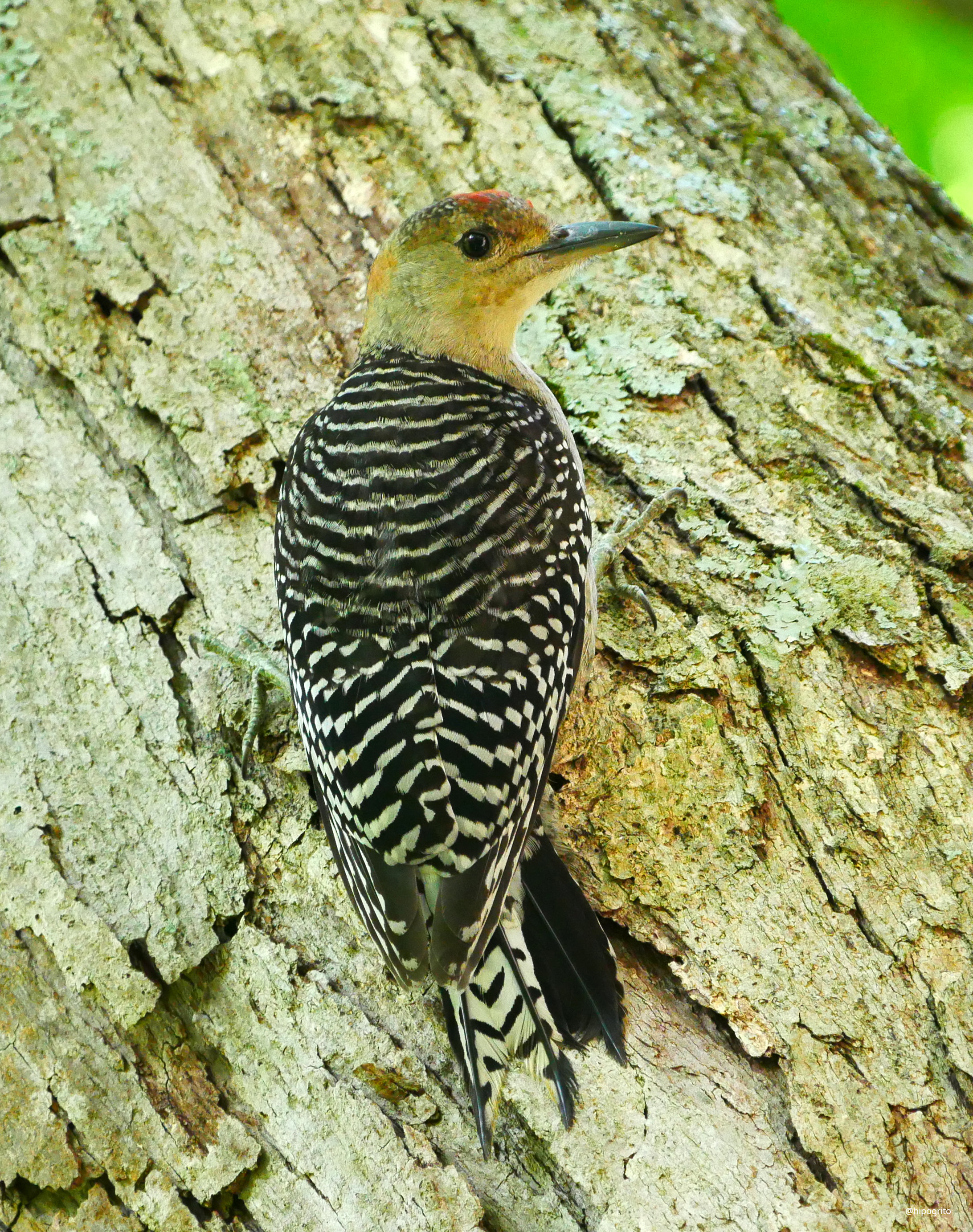
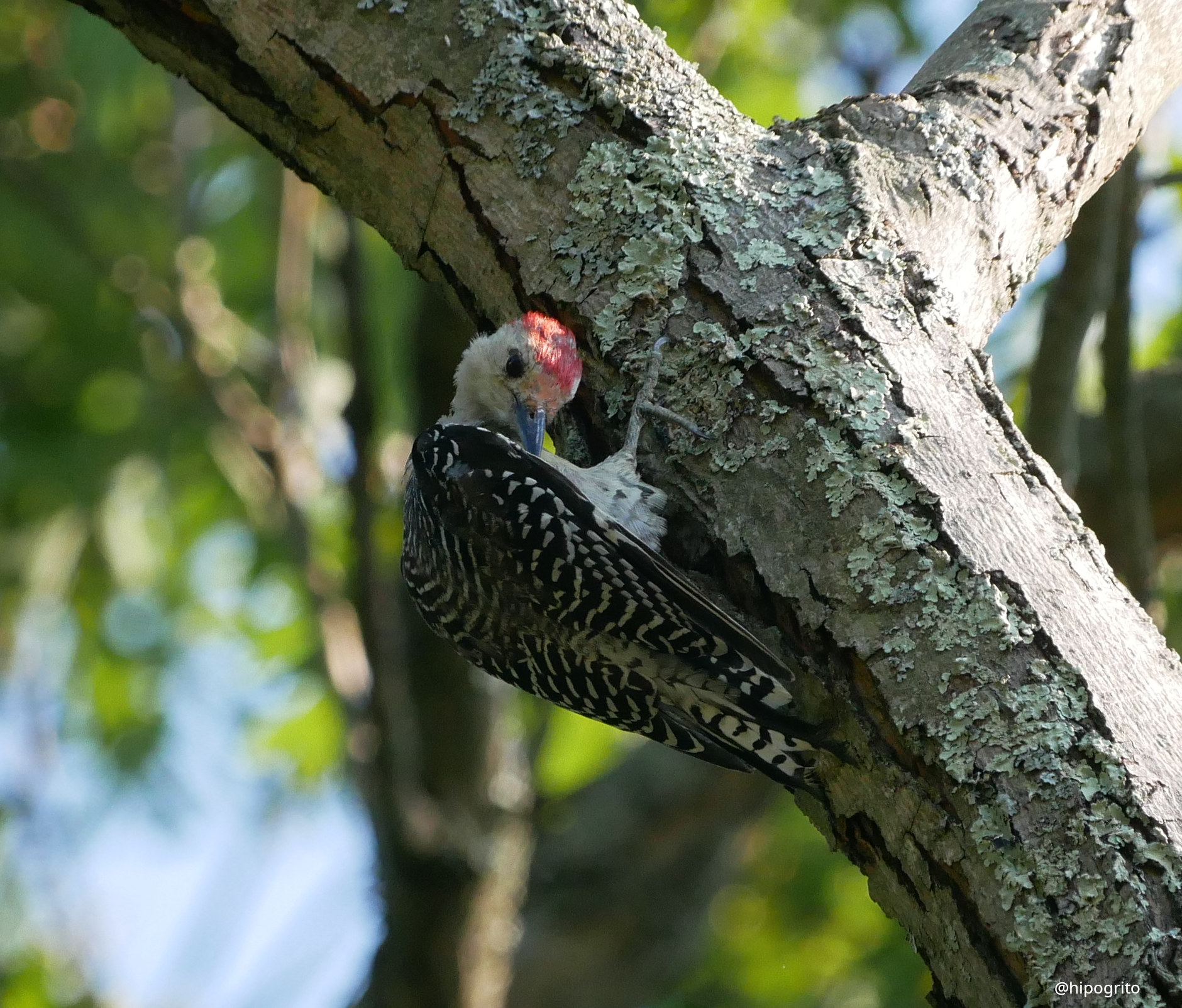
<a id='GBS.PA224.w.1.1.0'></a><p class='gtxt_body' style='text-indent:1em;' id='para.251.1.1.box.175.229.1004.173.q.101'>The Red-bellied woodpecker is a common woodpecker on Long Island and Southern New England and I don't know why Ralph Hoffmann didn't include it in this guide as it was already well known since the 1700's.</p>


<div class="responsive">
  <div class="gallery">
    <a target="_blank" href="../data/rb_09.JPG">
     
      <img src='../data/rb_09.JPG' style=' ' alt='Red-bellied Woodpecker'/>
    </a>
    <div class="desc">Long Island, NY, 2021</div>
  </div>
</div>

<div class="responsive">
  <div class="gallery">
    <a target="_blank" href="../data/rb_2022_w04.JPG">
     
      <img src='../data/rb_2022_w04.JPG' style=' ' alt='Red-bellied Woodpecker'/>
    </a>
    <div class="desc">Long Island, NY, 2022</div>
  </div>
</div>


<div class="responsive">
  <div class="gallery">
    <a target="_blank" href="../data/rb_2022_w08.JPG">
     
      <img src='../data/rb_2022_w08.JPG' style=' ' alt='Red-bellied Woodpecker'/>
    </a>
    <div class="desc">Long Island, NY, 2022</div>
  </div>
</div>


<div class="responsive">
  <div class="gallery">
    <a target="_blank" href="../data/rb_2022_w05.JPG">
     
      <img src='../data/rb_2022_w05.JPG' style=' ' alt='Red-bellied Woodpecker'/>
    </a>
    <div class="desc">Long Island, NY, 2022</div>
  </div>
</div>


<div class="responsive">
  <div class="gallery">
    <a target="_blank" href="../data/rb_2022_w06.JPG">
     
      <img src='../data/rb_2022_w06.JPG' style=' ' alt='Red-bellied Woodpecker'/>
    </a>
    <div class="desc">Long Island, NY, 2022</div>
  </div>
</div>


<div class="responsive">
  <div class="gallery">
    <a target="_blank" href="../data/rb_2022_w07.JPG">
     
      <img src='../data/rb_2022_w07.JPG' style=' ' alt='Red-bellied Woodpecker'/>
    </a>
    <div class="desc">Long Island, NY, 2022</div>
  </div>
</div>


<div class="responsive">
  <div class="gallery">
    <a target="_blank" href="../data/rb_2023_01.JPG">
     
      <img src='../data/rb_2023_01.JPG' style=' ' alt='Red-bellied Woodpecker'/>
    </a>
    <div class="desc">Northport, Long Island, NY, 2023</div>
  </div>
</div>


<div class="clearfix"></div>


</div>
<br/>
<div id='block.14.1.0.box.190.493.1018.1120.q.101' class='gtxt_body' style='margin-bottom: 1.5em;'>
<p class='gtxt_body' id='next_page' style="text-align: center;">
<a href="nighthawks.xml">Previous Page</a>
- 
<a href="toc.xml">Table of Contents</a>

-
<a href="kingfishers.xml">Next Page</a>

</p>
</div>


</div>
</body>
</html>